Best SPF Moisturizers: La Roche-Posay Leads

Five daily SPF moisturizers compared on published SPF, bottle size and stated formula. The winner gives you the most product per tube. One pick gives you the highest SPF number.

By Jessica TurnerUpdated 15 min read
On this page
- Best with spf moisturizer at a glance
- How I screened this category down to five
- Does a higher SPF number decide it?
- 1. La Roche-Posay Toleriane Double Repair UV SPF 30 Face — Best overall
- 2. CeraVe AM Facial Moisturizing Lotion SPF 50 — Best for families
- 3. CeraVe AM Oil Face Moisturizer Lotion — Best for heavy use
- 4. Cetaphil Daily Oil-Free Facial Moisturizer with Sunscreen — Best budget pick
- 5. e.l.f. SKIN Holy Hydration! Face Cream SPF 30 Sunscreen — Best lightweight
- How long does a 3 oz tube actually last?
- Zinc oxide or chemical filters: what the labels tell you
- What the listings do not tell you
- The verdict
- FAQ
The best with spf moisturizer for most faces is the La Roche-Posay Toleriane Double Repair UV SPF 30, because it packs 3.38 fl oz into one tube, the largest here, and pairs ceramide-3 with niacinamide. If you want the highest published SPF instead, the CeraVe AM Facial Moisturizing Lotion SPF 50 is the pick. Most shoppers compare SPF numbers first. That is not what separates these five.
Best with spf moisturizer at a glance
| Pick | SPF | Size | Price |
|---|---|---|---|
| 30 | 3.38 fl oz | Check Price | |
Best for families CeraVe AM Facial Moisturizing Lotion SPF 50 |
50 | 3 fl oz | Check Price |
Best for heavy use CeraVe AM Oil Face Moisturizer Lotion |
30 | 3 fl oz | Check Price |
Best budget pick Cetaphil Daily Oil-Free Facial Moisturizer with Sunscreen |
35 | 3 fl oz | Check Price |
Best lightweight e.l.f. SKIN Holy Hydration! Face Cream SPF 30 Sunscreen |
30 | 1.7 fl oz | Check Price |



How I screened this category down to five
I started from the face moisturizer listings inside Creams & Moisturizers and kept only products that publish an SPF figure on the label. Everything that sold as a night cream, a serum, or a moisturizer with no stated SPF was out immediately.
From there I lined up the published specifications side by side and compared four things:
- Stated SPF, because it is the one number every label carries and the only one that is standardised across brands.
- Volume per tube, in fluid ounces, which decides how many mornings a purchase covers.
- Named actives in the listing copy, specifically ceramides, niacinamide and hyaluronic acid.
- Position in this set on price, from the cheapest of the five to the most expensive.
That left five. What I could not screen for is texture, white cast or how any of these sit under foundation, because none of that is published data. It is manufacturer description at best, and I have flagged it as such throughout.
One note on the search itself. Amazon's results for this phrase mix moisturizers-with-SPF and dedicated facial sunscreens, and the line between the two is a marketing line, not a formulation one. Every pick below is sold as both.
Does a higher SPF number decide it?
Not on its own. The SPF figure tells you the multiplier on UVB protection at the tested application rate, which is a thick, even 2 mg per square centimetre. Almost nobody applies a daily moisturizer that heavily. Under-apply, and the real protection drops faster than the number suggests.
That is why the volume in the tube matters as much as the number on it. A generous, honest layer from an SPF 30 beats a stingy dab of SPF 50.
So the deciding criterion in the best with spf moisturizer category is how willingly you will use enough of it, every single morning. Three things drive that:
- Volume. The La Roche-Posay tube holds 3.38 fl oz. The e.l.f. jar holds 1.7 fl oz, roughly half. Same daily routine, twice the repurchase frequency.
- Feel. Both CeraVe picks and the Cetaphil are described as oil free and fast absorbing in their listings. That is the brand's own claim, but it is the property that decides whether you keep going.
- Cost position. The Cetaphil is the cheapest of the five and the La Roche-Posay the most expensive. Cheaper product used generously outperforms expensive product rationed.
Then take the SPF number as a tiebreaker. SPF 50 is genuinely more headroom than SPF 30, and if two picks feel identical to you, take the higher figure. It just should not override the first three.
1. La Roche-Posay Toleriane Double Repair UV SPF 30 Face — Best overall
The largest tube in this set at 3.38 fl oz, with ceramide-3 and niacinamide named in the formula, which makes it the one I'd default to for sensitive skin.
Best for: sensitive, dry skin that needs barrier support alongside SPF Skip it if: you want an SPF number above 30
Volume is what sets this apart within the set. At 3.38 fl oz it holds more than the three 3 fl oz tubes and roughly double the e.l.f. jar, and it sells faster than any other pick here, which for a repeat-purchase product like a morning moisturizer is worth noticing.
The formula is where the listing gets specific. La Roche-Posay says it combines prebiotic thermal water, ceramide-3, niacinamide and glycerin for up to 48 hours of hydration, and describes ceramide-3 as helping retain moisture while niacinamide works on the moisture barrier and visible discolouration. The brand also states the product is fragrance free, paraben free, oil free, alcohol free and non-comedogenic. Those are its claims, not measured results, but the actives list is the most detailed of the five and it matches what sensitive, reactive skin generally tolerates.
The trade-off is straightforward. It is the most expensive pick here and it stops at SPF 30 while a mid-priced alternative in this very set publishes SPF 50. You are paying for volume and formula, not for the biggest number.
Pros:
- Largest volume here at 3.38 fl oz
- Ceramide-3 and niacinamide both named in the formula
- Fragrance free, oil free and non-comedogenic per the brand
- The one buyers choose most often in this set
- Brand claims up to 48 hours of hydration
Cons:
- The most expensive pick here
- SPF 30 while the SPF 50 option costs less
- No published warranty or return term
- Only two sellers list it
2. CeraVe AM Facial Moisturizing Lotion SPF 50 — Best for families
The highest published SPF in this roundup at 50, in a mid-priced 3 fl oz tube, which makes it the easiest one to hand round a household.
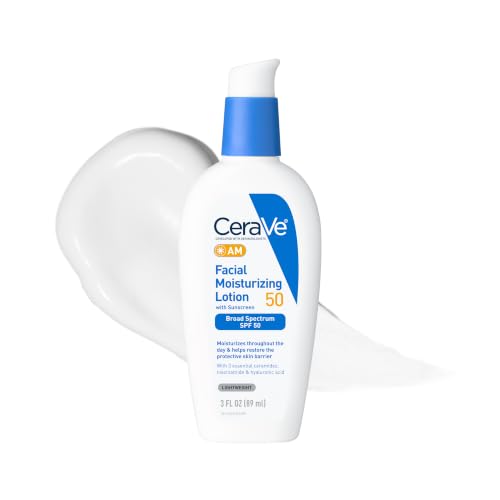
Best for: anyone who wants the highest published SPF in this set Skip it if: you prefer a formula with a longer track record
This is the only pick here that publishes SPF 50, and the gap to the SPF 30 options is real headroom, not marketing. It sits roughly mid-range for this set on price, so the higher figure costs less than the winner does.
CeraVe describes the sunscreen filter as micro-fine zinc oxide for UVA/UVB coverage, and says the lotion blends into all skin tones with no white residue. That last claim is worth flagging as a claim, because zinc oxide is exactly the filter type most prone to a white cast, and no published measurement backs it up. The brand lists hyaluronic acid to hold moisture, niacinamide to calm skin, and three ceramides, noting ceramides make up around 50% of the lipids in the skin barrier. The listing gives 2024 as the release year, so this is the newest formulation of the five.
Two catches. At 3 fl oz you get less product than the winner for a similar daily habit, and being new, it has the shortest history of any pick here. It also sells more slowly than three of the other four.
Pros:
- Only SPF 50 in this set
- Mid-range price position for the highest SPF here
- Zinc oxide filter with three ceramides listed
- Newest formulation, released 2024
Cons:
- 3 fl oz, less than the 3.38 fl oz winner
- Newest formula, shortest track record here
- No-white-cast claim is the brand's, not measured
- Sells more slowly than most of this set
3. CeraVe AM Oil Face Moisturizer Lotion — Best for heavy use
The heaviest tube here at 4.32 oz on the scale despite holding 3 fl oz, with a Skin Cancer Foundation daily-use recommendation stated on the listing.

Best for: daily zinc oxide users who reapply generously Skip it if: SPF 30 feels too low for long outdoor days
This is the veteran of the group. The listing gives 2014 as the release year, a full decade ahead of the SPF 50 version, and it is the second-fastest seller of the five. If a formula has stayed on shelves that long without reformulating away from what it is, that is a signal worth something.
CeraVe specifies micro-fine zinc oxide for broad spectrum SPF 30, plus hyaluronic acid, niacinamide and essential ceramides, and describes MVE Technology as delivering hydration through the day. The listing also states the product is recommended for daily use by the Skin Cancer Foundation, and it is the only pick here that cites any third-party body at all. Fragrance free, oil free, non-comedogenic and paraben free are all on the label per the brand. The stated packed weight of 4.32 oz is the highest here, which points to a denser bottle rather than more product.
Within this set, it is hard to justify over its own SPF 50 sibling. Same brand, same filter type, same 3 fl oz, lower SPF, and it sits in the same upper price territory as the winner.
Pros:
- Longest-running formula here, released 2014
- Skin Cancer Foundation daily-use recommendation stated
- Zinc oxide filter plus ceramides and niacinamide
- Second-fastest seller in this set
Cons:
- SPF 30 when the same brand's SPF 50 costs less
- 3 fl oz, less product than the winner
- Priced in the upper band for the lower SPF
- Only two sellers list it
4. Cetaphil Daily Oil-Free Facial Moisturizer with Sunscreen — Best budget pick
The cheapest of the five and it still publishes SPF 35, which is a higher figure than three of the four pricier picks.

Best for: combination, sensitive skin on a tight budget Skip it if: you want ceramides in the formula
The value case here is arithmetic. SPF 35 in a 3 fl oz tube, at the lowest price position in this roundup, beats both SPF 30 options on the label figure while costing less than either. If you have been buying an SPF 30 day cream and paying more, this is the comparison to sit with.
Cetaphil calls it a three-in-one that hydrates, nourishes and protects sensitive, combination skin, and names edelweiss flower extract as the barrier-repair ingredient. The listing states broad spectrum SPF 35 against UVA and UVB, and describes the texture as fast absorbing, non-greasy and pore-safe. Fragrance free and paraben free are both on the label. The listing gives 2020 as the release year and 2.88 oz as the packed weight, the second lightest here.
Where it loses is the actives sheet. There is no mention of ceramides, niacinamide or hyaluronic acid, and no filter type is named, so you cannot tell from the listing whether it is a mineral or a chemical formula. Both CeraVe picks and the winner publish more. It is also the slowest seller of the five.
Pros:
- Cheapest of the five picks
- SPF 35 beats three pricier picks on label figure
- Edelweiss extract named for barrier repair
- Fragrance free and paraben free per the brand
- Full 3 fl oz tube
Cons:
- No ceramides, niacinamide or hyaluronic acid listed
- Filter type not stated on the listing
- Slowest seller in this set
- Thinnest published ingredient detail here
5. e.l.f. SKIN Holy Hydration! Face Cream SPF 30 Sunscreen — Best lightweight
The smallest and lightest pick at 1.7 fl oz and 1.76 oz packed, and the second cheapest, which makes it the obvious one to try a texture on before committing.

Best for: makeup wearers who want the smallest, lightest jar Skip it if: you need more than 1.7 fl oz per tube
Size is the whole story here, in both directions. At 1.7 fl oz this is half the volume of the winner, and at 3.15 x 2.44 x 2.44 in it is the only pick shaped as a squat jar rather than a tall tube. That footprint fits a small bag in a way a 6-inch tube does not.
e.l.f. describes it as a broad spectrum SPF 30 designed for everyday wear under makeup without heavy residue or white cast, and names hyaluronic acid for hydration plus a niacinamide-and-peptides complex for tone and pore refinement. The brand calls the texture fast absorbing and non-greasy, and says it suits oily, dry, combination and sensitive skin. The listing also notes support for Get Blue via Water.org, which is a brand commitment rather than a product property. Release year is given as 2021.
The volume is the problem. Half the product means twice the repurchase cycle, and even at the second-cheapest price position, that maths can catch up with you fast if you apply a proper layer every morning.
Pros:
- Smallest footprint at 3.15 x 2.44 x 2.44 in
- Second cheapest pick here
- Hyaluronic acid, niacinamide and peptides all listed
- Lightest packed weight at 1.76 oz
Cons:
- Only 1.7 fl oz, half the winner's volume
- Fastest to run out of any pick here
- SPF 30, the lowest figure in this set
- Filter type not stated on the listing
How long does a 3 oz tube actually last?
Nobody publishes this, so here is how to work it out for yourself rather than trust a guess.
A properly generous face application is roughly a quarter teaspoon, or about a third of a teaspoon if you include ears and neck. A US fluid ounce holds six teaspoons. So a 3 fl oz tube gives you around 18 teaspoons of product, which lands somewhere near 55 to 70 daily applications at a quarter teaspoon each.
That puts the four 3 fl oz picks in the same rough territory: roughly two months of once-daily use. The La Roche-Posay tube at 3.38 fl oz stretches a little past that. The e.l.f. jar at 1.7 fl oz gives you around half, so closer to a month.
Two things shift the maths:
- Reapplication. Applying twice daily halves every number above.
- Under-applying. Stretching a tube to four months means you were not using enough to hit the label SPF.
Track how long your first tube lasts and compare it against 55 applications. If it went much further, the SPF on the box is not the SPF on your face.
Zinc oxide or chemical filters: what the labels tell you
Only two of these five listings name a filter type, and both are CeraVe. Both specify micro-fine zinc oxide, which is a mineral filter that works by sitting on the skin surface. Mineral filters have a reputation for a white cast, which is exactly why CeraVe's own copy pre-empts it with a no-white-residue claim on the SPF 50 lotion.
The other three, La Roche-Posay, Cetaphil and e.l.f., describe broad spectrum coverage without naming what delivers it. That is not unusual and it is not a red flag, but it does mean you cannot judge mineral versus chemical from the listing alone. Check the drug facts panel on the box.
Why it matters for a best with spf moisturizer:
- Mineral filters suit reactive skin and children, and are less likely to sting near the eyes.
- Chemical filters generally go on clearer and thinner, which is the usual reason a formula sits well under makeup.
- Tone is the practical variable. On deeper skin tones a zinc formula is more likely to leave a grey or ashy finish, and no listing here quantifies that.
If a white cast has burned you before, start with a listing that names its filter so you know what you are getting.
What the listings do not tell you
Every one of these five products is described as lightweight, fast absorbing and non-greasy. That is the entire category's copy, and it is not evidence of anything. Here is what the published data leaves out.
- Texture and finish. Matte, dewy, tacky: not published for any pick.
- Performance under makeup. Claimed by e.l.f., not measured by anyone.
- White cast on deeper skin tones. Only addressed as a claim on the CeraVe SPF 50.
- Water resistance. No pick publishes a water-resistance rating in minutes.
- Full ingredient lists. Highlights only. The actual INCI list sits on the packaging.
- Warranty or satisfaction terms. None of the five publishes one.
Also worth noting: none of these five carries a published guarantee, so the deciding factor on formula fit is your own skin's response over a fortnight, not anything on the page.
Two useful proxies exist in the data. Volume is objective, and so is the stated SPF figure. Those two will get you a defensible choice, and the rest is trial.
The verdict
If you have sensitive or dry skin and want the most product for a daily habit, buy the La Roche-Posay Toleriane Double Repair UV SPF 30. It holds 3.38 fl oz, more than any other pick here, and names ceramide-3, niacinamide and glycerin in the formula. It is the one buyers reach for most often in this set, and it is the safest default for skin that reacts.
If your priority is the highest number on the label, buy the CeraVe AM Facial Moisturizing Lotion SPF 50. It is the only SPF 50 among these five, it uses a micro-fine zinc oxide filter, and it sits mid-range on price rather than at the top.
The cutoff is 3 fl oz of committed daily use. If you will genuinely apply a quarter teaspoon every morning and go through a tube in two months, take the La Roche-Posay for the extra volume and the ceramides. If you apply less often, or you reapply outdoors and want the extra UVB headroom on the days you are out, take the SPF 50.
The runner-up's exact advantage is that SPF 50 for less money than SPF 30 costs from the winner. That is a real gap, and it is the only reason to pass on the top pick.
FAQ
Is a with spf moisturizer worth buying over separate products?
A with spf moisturizer is worth it if the alternative is skipping sunscreen because two steps feel like too many. One tube means one habit. The trade-off is control: you cannot adjust your moisturizer and your SPF layer independently, and you cannot reapply SPF at midday without reapplying moisturizer too.
Which is better value, the Cetaphil or the CeraVe SPF 50?
Better value between the Cetaphil and the CeraVe SPF 50 depends on which spec you weight. The Cetaphil is the cheapest of the five and publishes SPF 35 in a 3 fl oz tube. The CeraVe sits mid-range and publishes SPF 50, plus three ceramides, niacinamide and hyaluronic acid in the same 3 fl oz. Pay more only for the higher SPF and the actives list.
Does the SPF number matter more than the size of the tube?
The SPF number matters less than most shoppers assume, because label figures come from a thick test application almost nobody replicates. A 3.38 fl oz tube you use generously outperforms a 1.7 fl oz jar you ration. Compare volume first, then take the SPF figure as a tiebreaker between products that feel equally good on your skin.
Can I use these under makeup without pilling?
Using these under makeup is what several listings claim to support, but none of it is measured. e.l.f. specifically says its cream is designed for everyday wear under makeup with no heavy residue, and the two CeraVe lotions and the Cetaphil are all described as fast absorbing and non-greasy. Pilling depends on your primer and foundation, so test on one small area first.
What is the most common mistake buying an SPF moisturizer?
The most common mistake is buying a small container and then under-applying to stretch it. At a quarter teaspoon per face, a 3 fl oz tube covers roughly 55 to 70 applications and a 1.7 fl oz jar around half that. Stretching a tube past four months of daily use means you never reached the SPF printed on the box.
Pick the tube you will empty. That single decision does more for your skin than moving from SPF 30 to SPF 50 while rationing the product, and it is the reason the La Roche-Posay wins here on 3.38 fl oz rather than on any headline number. Check the drug facts panel when it arrives, use a full quarter teaspoon each morning, and note the date you open it. If the tube runs dry in about two months, you are applying enough. If it lasts twice that, buy a bigger one next time and use more.