Best Rosehip Face Oil for Sensitive Skin: The Ordinary Wins

Seven single-ingredient rosehip oils, ranked for sensitive skin by ingredient list, extraction method, and bottle format. The Ordinary leads. Here is why, and when to pick something else.

By Jessica TurnerUpdated 17 min read
On this page
- Best rosehip face oil for sensitive skin at a glance
- How I narrowed seven rosehip oils down
- Does rosehip oil actually suit sensitive skin?
- 1. The Ordinary 100% Organic Cold-Pressed Rose Hip Seed Oil — Best overall
- 2. MMPANG Organic Rosehip Seed Oil for Face — Best upgrade
- 3. Kate Blanc Cosmetics Rosehip Seed Oil for Face — Best for families
- 4. PURSONIC Pure Cold Pressed Rosehip Seed Oil for Face — Best minimal setup
- 5. Cliganic Organic Rosehip Seed Oil for Face — Most versatile
- 6. BodyJ4You Rosehip Seed Oil for Face Skin — Best lightweight
- 7. The Organic Forest 100% Plant-Based Rosehip Oil — Best budget pick
- Cold-pressed, organic, single-ingredient: what each label means
- How long does a 1 fl oz bottle really last?
- What the listings do not tell you
- The verdict
- FAQ
The best rosehip face oil for sensitive skin is The Ordinary 100% Organic Cold-Pressed Rose Hip Seed Oil, a 1 fl oz single-ingredient bottle that keeps the formula down to one thing your skin has to accept or reject. If you want the same cold-pressed, USDA-certified profile at an entry price, MMPANG's 1 fl oz bottle is the runner-up. The deciding specification here is what is not in the bottle: fragrance, preservatives, carriers. Every pick in this set is a single-ingredient oil, so the choice comes down to certification, bottle size, and brand track record.
Best rosehip face oil for sensitive skin at a glance
| Pick | Extraction | Certification claim | Price |
|---|---|---|---|
| Cold-pressed | 100% organic (brand claim) | Check Price | |
Best upgrade MMPANG Organic Rosehip Seed Oil for Face |
Cold-pressed | USDA certified (brand claim) | Check Price |
Best for families Kate Blanc Cosmetics Rosehip Seed Oil for Face |
Cold-pressed (implied) | 100% pure, organic (brand claim) | Check Price |
Best minimal setup PURSONIC Pure Cold Pressed Rosehip Seed Oil |
Cold-pressed | Pure single-ingredient (brand claim) | Check Price |
Most versatile Cliganic Organic Rosehip Seed Oil for Face |
Cold-pressed | USDA organic, non-GMO (brand claim) | Check Price |
Best lightweight BodyJ4You Rosehip Seed Oil for Face Skin |
Cold-pressed | USDA organic, hexane-free (brand claim) | Check Price |
Best budget pick The Organic Forest 100% Plant Based Rosehip Oil |
Cold-pressed | Pure organic (brand claim) | Check Price |



How I narrowed seven rosehip oils down
Choosing the best rosehip face oil for sensitive skin is not about finding the fanciest bottle. It is about finding the shortest ingredient list you can trust and the extraction method that keeps the fatty acids intact. Every product in this set claims a single ingredient: cold-pressed rosehip seed oil. That is the baseline.
My screening ran in three passes. First, I set a hard filter on formulation: any oil with added carriers, fragrance, or preservatives was out, because a reactive face does not need extras. All seven survived that cut. Second, I looked for a stated extraction method. Cold-pressed is the standard for keeping vitamin content and fatty acid profile intact, and every pick here claims it. Third, I compared certifications. Four listings explicitly claim USDA organic certification (MMPANG, Cliganic, BodyJ4You, The Ordinary). Two describe themselves as organic without naming the certifying body (Kate Blanc, The Organic Forest). Pursonic describes itself as pure and cold-pressed without an organic claim.
What I did not do is test these on skin. I cannot. What I did do is line up the specifications, the extraction claims, and the certifications side by side, then think about which combination makes the most sense for a face that reacts to almost everything.
Does rosehip oil actually suit sensitive skin?
Here is where the keyword needs a caveat. Amazon returned these seven listings for a sensitive-skin query, but not one of them is formulated specifically for sensitive skin. They are all general-purpose rosehip oils. Only two feature bullets in the entire input mention sensitive skin: The Organic Forest says its formula is "suitable for all skin types including oily and sensitive skin", and The Ordinary says its oil is "gentle enough for daily use". Neither is a dermatologist-tested sensitive-skin claim.
That is not a dealbreaker. Rosehip seed oil, as a category, has a reputation for being well-tolerated because the ingredient list is short. But short is not the same as safe for you. Reactive skin can flare from anything, including single-ingredient plant oils. So treat every pick here as a candidate, not a guarantee.
The Ordinary's listing gives the most cautious application guidance: "Apply a few drops to the face once daily, ideally at bedtime. Patch test before use and avoid broken skin." That is the sentence sensitive-skin buyers should look for. A patch test on the inner forearm for two or three nights before the face is standard practice, and no listing here excuses you from it.
1. The Ordinary 100% Organic Cold-Pressed Rose Hip Seed Oil — Best overall
The Ordinary's 1 fl oz bottle is the pick because the listing gives the clearest formulation story and the most cautious use guidance of the seven.
Best for: someone building a minimalist routine around one trusted single-ingredient oil Skip it if: you want a larger bottle for body and hair use
Within this set, The Ordinary is the one buyers choose most often here, and the listing does the least hedging about what is inside. It states 100% organic, cold-pressed, and unrefined, and the application note tells you to patch test and avoid broken skin. That last line matters for reactive skin. The bottle measures 4.5 x 1.31 x 1.31 in and weighs 1.06 oz, which is a slim upright that fits in a bathroom cabinet without taking a shelf. The colour is described as yellow on the listing, which is consistent with an unrefined cold-pressed oil.
Where does this lose ground? It sits in the most expensive pick position of this set, and the bottle is the standard 1 fl oz. If you want a bottle you can also use on hair or body without watching the level drop, the 6 fl oz Pursonic makes more sense. If you want the same certification profile at an entry price, MMPANG is the direct rival. The Ordinary earns the top spot on documentation, not on price.
Pros:
- 100% organic, cold-pressed, unrefined per listing
- Explicit patch-test guidance in application notes
- The one buyers choose most often here
- Slim 4.5 in bottle fits standard cabinet shelves
- Single-ingredient formula with no carrier oils
Cons:
- The most expensive pick here
- Only 1 fl oz, so not for multi-use routines
- Just two sellers list it, so stock can shift
2. MMPANG Organic Rosehip Seed Oil for Face — Best upgrade
MMPANG matches the certification story at an entry price, which makes it the direct alternative when The Ordinary is out of reach.

Best for: a nightly facial routine with a cold-pressed, USDA-certified bottle at an entry price Skip it if: you prefer a brand with a longer track record on shelves
MMPANG is the second-cheapest here and sits in the entry price band, which is unusual for an oil that claims USDA certification and cold-press extraction. The listing describes the oil as "meticulously extracted from high-quality Canis rose using the cold-press method" and adds that it is "non-comedogenic". The bottle dimensions are 1.5 x 4.3 x 1.5 in, so a standard tall dropper. Colour is listed as "Original", which is less useful than The Ordinary's plain "yellow".
The trade-off is brand history. MMPANG is a less-established name in this set, and the listing does not name the certifying body behind its USDA claim beyond the certification itself. For a reactive-skin buyer, that is a soft point: the ingredient story reads well, but the accountability behind it is shallower than The Ordinary's. If you have already used rosehip oil and know your skin tolerates it, that gap matters less. If this is your first rosehip bottle, The Ordinary is the safer opening move.
Pros:
- Entry price band with USDA certification claim
- Cold-press extraction stated on the listing
- Non-comedogenic claim in feature bullets
- Standard 1 fl oz dropper for daily use
- Cheaper than The Ordinary at the same size
Cons:
- Newer brand with a shorter shelf history
- Certifying body not named beyond "USDA"
- Colour listed only as "Original", less descriptive
3. Kate Blanc Cosmetics Rosehip Seed Oil for Face — Best for families
Kate Blanc's bottle is the one to buy when the oil will get used for facial massage and gua sha as well as skincare.

Best for: a shared bathroom where the same bottle gets used for gua sha, hair, and face Skip it if: you want the smallest possible ingredient story for reactive skin
Kate Blanc's listing leans into multi-use in a way most of the set does not. It calls out gua sha explicitly: "Our organic 100% pure rosehip oil creates a smooth glide for gua sha, making it ideal for use with facial massage tools." That is a specific use case. It also mentions scalp and hair application. The bottle is compact at 4 x 1.25 x 1.25 in, and colour is described as light orange, which reads as a slightly refined tone compared with The Ordinary's yellow.
Kate Blanc sits in the entry price band and is the third-cheapest of the seven, which makes the versatility case stronger. The trade-off is that the listing does not name a certifying body for its organic claim, which puts it a notch below MMPANG on paperwork. For a family bathroom where multiple people dip into the same bottle, that matters less than convenience. For a single sensitive-skin user who wants the shortest possible chain of trust, The Ordinary still wins.
Pros:
- Explicit gua sha and facial massage use case
- Entry price band for a versatile daily oil
- Compact 4 in bottle for shared shelves
- Multipurpose: hair, scalp, nails on the listing
- Light orange colour indicates a cold-pressed profile
Cons:
- Certifying body for organic claim not named
- Multi-use framing may not suit reactive skin
- No stated extraction temperature or method detail
4. PURSONIC Pure Cold Pressed Rosehip Seed Oil for Face — Best minimal setup
Pursonic is the only 6 fl oz bottle in the set, which changes the reorder rhythm from monthly to seasonal.

Best for: someone who wants to buy once and stop reordering for months Skip it if: you dislike opening a big bottle daily and prefer a fresh 1 fl oz
Every other product in this set is a 1 fl oz bottle. Pursonic is 6 fl oz. That is the differentiator, and it is the reason to pick it. The bottle measures 5.6 x 2 x 2 in and weighs 6.74 oz. If you use two or three drops nightly, a 1 fl oz bottle runs out in a few months; a 6 fl oz bottle lasts far longer. For someone who has already patch-tested rosehip oil and confirmed their skin tolerates it, the 6 fl oz format is a genuine convenience.
The trade-off is real. A bigger bottle sits open longer, and oils oxidise over time. The listing does not state a shelf life or a preservation approach, and it does not name a USDA certification. Pursonic sits in the mid price band and calls itself "pure" and "cold-pressed" rather than "organic". For a first-time rosehip user with reactive skin, that is a softer story than The Ordinary's. Buy this after you know the ingredient works for you, not before.
Pros:
- Only 6 fl oz bottle in the set
- Mid price band across the whole seven
- Cold-pressed and single-ingredient per listing
- Amber glass and dropper format on the listing
- Multi-use: face, hair, nails, scalp
Cons:
- No organic certification claim
- Larger bottle stays open longer, risking oxidation
- Slowest-selling of the seven picks
- Released in 2017, so an older SKU on the shelf
5. Cliganic Organic Rosehip Seed Oil for Face — Most versatile
Cliganic pairs a USDA organic claim with a non-GMO project verified badge, which is the most-stacked paperwork in the set.

Best for: a face, hair, and body user who wants USDA organic and non-GMO on the label Skip it if: the packaging refresh note on the listing puts you off
Cliganic's listing lists more certifications than any other pick: USDA organic certified, non-GMO project verified, certified vegan, cruelty-free. The bottle is 4.33 x 1.57 x 1.57 in and weighs 1.76 oz, so a slightly wider profile than The Ordinary. The listing shows a 2025 released date and includes a note that "Packaging May Vary - New look, same great product", which explains any inconsistency between what you see in photos and what arrives.
Cliganic sits in the premium price band and is the fifth-cheapest of the seven, so mid-pack on cost. The trade-off against The Ordinary is subtle. The Ordinary's application note is more specific for reactive skin (patch test, avoid broken skin), while Cliganic's feature bullets emphasise the certification stack instead. If you weigh paperwork over application guidance, Cliganic wins; if you weigh caution language, The Ordinary does.
Pros:
- USDA organic and non-GMO project verified claims
- Certified vegan and cruelty-free on the listing
- Single-ingredient formula, no synthetic additives
- Multipurpose for face, hair, and body
- Released 2025, so a current SKU
Cons:
- Premium price band without a size advantage
- Packaging variation note may cause confusion
- No specific sensitive-skin guidance in features
6. BodyJ4You Rosehip Seed Oil for Face Skin — Best lightweight
BodyJ4You's listing leans on a "lightweight, fast-absorbing" claim and a hexane-free extraction, which is a specific detail few others state.
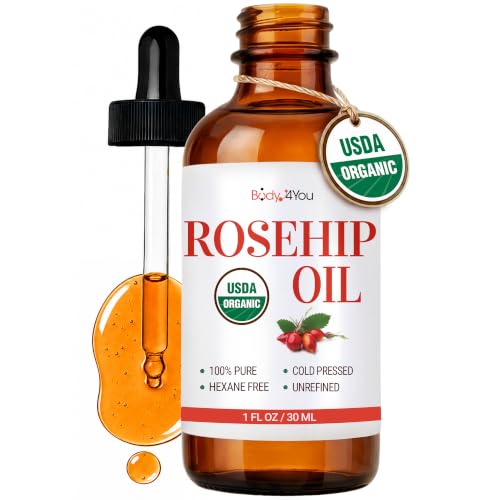
Best for: someone who dislikes any greasy afterfeel and wants a fast-absorbing amber-glass bottle Skip it if: you already own a similar oil from a more established brand
BodyJ4You's feature bullets do two things that matter here. First, they claim the oil is "hexane free", which is a solvent extraction detail worth calling out because it distinguishes the oil from cheaper solvent-extracted alternatives outside this set. Second, they describe the texture as "lightweight" and "absorbs fast without a greasy feel". Every rosehip oil claims fast absorption, but only BodyJ4You pairs it with the hexane-free note. The bottle is described as amber glass, which shields the oil from UV.
The trade-off is that BodyJ4You is the sixth-cheapest of the seven and sits in the premium price band, without a larger size or extra certification stack to justify the position. The listing also has the second-highest sales rank in this set, so it sells more slowly than the others. That is not a quality signal against it; it is a visibility signal. If the lightweight framing and hexane-free line both matter to you, this is a considered buy.
Pros:
- Hexane-free extraction stated on listing
- Lightweight, fast-absorbing texture claim
- Amber glass 1 fl oz dropper for UV protection
- USDA organic and vegan claims on listing
- Brand states over 20 years in skincare
Cons:
- Premium price for a standard 1 fl oz size
- Slowest seller of the six 1 fl oz bottles
- Less-recognised brand than The Ordinary
7. The Organic Forest 100% Plant-Based Rosehip Oil — Best budget pick
The Organic Forest is the cheapest of the seven, which makes it the pick for a first-time rosehip user who wants a low-commitment trial.

Best for: a first-time rosehip user testing whether the oil suits their skin Skip it if: colour and clarity matter to you as a freshness signal
The Organic Forest is the cheapest of the six, and it sits in the entry price band. The listing describes the oil as clear in colour, which is unusual: a genuinely unrefined cold-pressed rosehip oil is typically golden to amber. Clear may signal a lighter refined grade, or it may simply be listing-photo variance. The listing does not clarify. The bottle is 3.74 x 1.38 x 1.38 in and weighs 3.17 oz, so a slightly chunkier bottle than The Ordinary.
The listing does explicitly claim suitability for sensitive skin: "Absorbs quickly without leaving an oily residue, making it suitable for all skin types including oily and sensitive skin." That is one of only two listings in the set with a sensitive-skin mention. Against The Ordinary, the trade-off is brand documentation and colour clarity. Against MMPANG, the trade-off is that MMPANG names a USDA claim while The Organic Forest does not. Buy this to test the ingredient, then upgrade if your skin agrees with it.
Pros:
- Cheapest of the seven picks
- Explicit sensitive-skin mention in feature bullets
- Cold-pressed and organic per listing
- Entry price band for a first trial
- Non-greasy formula claim in features
Cons:
- Clear colour may suggest refined rather than raw
- Slowest-selling pick in the whole set
- No USDA certification claim on listing
Cold-pressed, organic, single-ingredient: what each label means
These three phrases repeat across every listing here, and they are not interchangeable. Understanding them is how you avoid overpaying for a phrase that does not tell you what you assume.
- Cold-pressed describes the extraction method. Seeds are pressed mechanically without heat or solvents, which preserves the fatty acid profile and fat-soluble vitamins. Every pick here claims cold-pressed extraction. It is table stakes for a face oil, not a differentiator.
- Organic describes the growing method for the source plant. A USDA organic certification, when stated with the certification body named, is auditable. A brand describing itself as organic without naming the certifying body is a claim, not a certification. In this set, MMPANG, Cliganic, BodyJ4You, and The Ordinary claim organic status; Cliganic and BodyJ4You name USDA specifically.
- Single-ingredient means the bottle contains only rosehip seed oil, with no carrier oils, fragrance, preservatives, or vitamin E added. All seven picks here claim single-ingredient formulation. For sensitive skin, this is the phrase that matters most: fewer ingredients means fewer possible triggers.
- Non-comedogenic appears in MMPANG's feature bullets and is implied elsewhere. Rosehip seed oil is generally rated low on comedogenicity scales, but "non-comedogenic" is a brand claim, not a regulated term.
The trick for sensitive skin: prioritise single-ingredient first, cold-pressed second, and named certification third. Skip anything that adds fragrance, botanical extracts, or "complex" language on the label.
How long does a 1 fl oz bottle really last?
This is the practical question no listing answers directly. Here is what the numbers suggest.
- A standard glass dropper releases roughly 20 drops per millilitre of oil.
- One fluid ounce is about 29.5 millilitres, so a 1 fl oz bottle contains roughly 590 drops.
- Most listings here recommend two to three drops per application. BodyJ4You's bullet is explicit: "Warm 2 to 3 drops between fingertips and press into clean damp skin every morning and night."
If you follow BodyJ4You's twice-daily guidance at three drops per use, that is six drops a day. A 1 fl oz bottle lasts roughly 98 days. If you follow The Ordinary's once-daily bedtime guidance at three drops, that is three drops a day, and the bottle lasts around 196 days. Pursonic's 6 fl oz bottle scales that up by six.
Two things affect the real figure. The dropper size varies, so your drops-per-ml can be higher or lower than 20. And once opened, oils start oxidising, which is why a smaller bottle used up quickly is often a smarter buy than a big bottle stretched over a year, especially without a refrigerated storage habit. For reactive skin, buy small, use fresh, reorder often.
What the listings do not tell you
Here is where the input has gaps you should know about. None of these seven listings publishes a shelf life or a "best used within" period after opening. None publishes a batch cold-press date. None names the country of origin for the rosehip seeds. Kate Blanc, MMPANG, and The Organic Forest do not name a certifying body for their organic claims. Only Cliganic states a release year (2025), and Pursonic states a release year (2017), which is a proxy for how long the SKU has been on the shelf but not for the freshness of the bottle you receive.
For sensitive skin, three things would help that no listing provides: a fatty acid profile with linoleic acid percentage, an oxidation-resistance measure or peroxide value, and a fragrance-free explicit declaration (implied by single-ingredient status but not stated). If you have a dermatologist you trust, ask them which of these matters for your skin. If you do not, patch test for three nights on the inner forearm, wait, then patch test on the jawline for three more nights before going full-face. That routine catches most reactions before they hit the whole face.
The verdict
The winner is The Ordinary 100% Organic Cold-Pressed Rose Hip Seed Oil. It earns the top spot because the listing does three things at once: it commits to cold-pressed extraction, it claims 100% organic status, and it gives explicit application caution (patch test, avoid broken skin) that no other listing matches. For a sensitive-skin buyer opening a rosehip bottle for the first time, that combination is the safest starting point in this set.
The cutoff is confidence. If you already know your skin tolerates rosehip oil and you want a bigger bottle to cover face, hair, and body, Pursonic's 6 fl oz is the better buy at a mid price band. If you want the same certification story as The Ordinary at an entry price, MMPANG is the direct rival, and the paperwork difference is small enough to make it a fair swap for a return buyer. If your budget is tight and you are testing the ingredient for the first time, The Organic Forest is the cheapest way to run the experiment.
The Ordinary loses on price and size. It wins on documentation. For a face that reacts to almost anything, that is the trade worth making on the first bottle.
FAQ
Is rosehip oil safe for sensitive skin?
Rosehip oil is generally well-tolerated by sensitive skin because single-ingredient cold-pressed formulas contain no fragrance, no preservatives, and no botanical extracts. But sensitive skin varies. Two listings here (The Ordinary and The Organic Forest) explicitly mention gentleness or sensitive-skin suitability. Patch test any new oil for three nights on your inner forearm before applying it to your face, whether the listing mentions sensitive skin or not.
Is The Ordinary rosehip oil worth it over MMPANG?
The Ordinary rosehip oil is worth it over MMPANG when you want the more established brand and the explicit patch-test guidance in the application note. Both bottles are 1 fl oz, cold-pressed, and single-ingredient. MMPANG matches the profile at an entry price and adds a USDA claim. If you have used rosehip oil before, MMPANG is the value pick; if this is your first bottle, The Ordinary is the safer trial.
How many drops of rosehip oil should I apply?
How many drops of rosehip oil depends on your routine, but the listings here suggest two to three drops per application. BodyJ4You's bullet specifies two to three drops warmed between fingertips and pressed into clean, damp skin morning and night. The Ordinary recommends a few drops once daily at bedtime. Start with two drops nightly, and increase only if your skin feels dry the following morning.
Kate Blanc vs Cliganic: which is better for sensitive skin?
Kate Blanc vs Cliganic comes down to certification versus versatility. Cliganic stacks USDA organic, non-GMO project verified, vegan, and cruelty-free claims on its listing. Kate Blanc's listing emphasises gua sha, facial massage, and multi-use across hair and face, and sits in the entry price band rather than premium. For sensitive skin specifically, Cliganic's deeper certification story is the safer bet. For a shared household bottle, Kate Blanc is more useful.
What should I avoid in a rosehip face oil?
What you should avoid in a rosehip face oil is any ingredient that is not rosehip seed oil. Skip bottles with added fragrance, essential oils, botanical extracts, vitamin E as a preservative, or carrier oils like jojoba or almond blended in. For sensitive skin, single-ingredient is non-negotiable. Also avoid oils without a stated extraction method: cold-pressed should be printed clearly, because heat extraction damages the fatty acid profile.
Start with The Ordinary if you have never used rosehip oil before, because the listing gives the clearest application guidance and the strongest documentation of the seven. Buy one 1 fl oz bottle, patch test for three nights on your inner forearm, then work up to nightly face application over a week. If your skin agrees with the ingredient, your next reorder can move to MMPANG for the same profile at a lower price, or to Pursonic's 6 fl oz for a longer reorder cycle. If your skin does not agree, you have lost only one small bottle, which is the whole point of starting with the most cautious pick.