Best Gua Sha for Jawline by Weight and Edge Shape

Six gua sha tools compared for jawline work, from a 3.17 oz stainless steel plate to a built-in roller cream. The winner splits by whether you want metal, stone or a hybrid.

By Jessica TurnerUpdated 15 min read
On this page
- Best gua sha for jawline at a glance
- How I narrowed the field to six
- 1. Rena Chris Gua Sha Facial Tools — Best overall
- 2. Rena Chris Jade Stone Guasha Tool — Best budget pick
- 3. Kitsch Stainless Steel Guasha Tool — Best upgrade
- 4. BAIMEI IcyMe Gua Sha & Jade Roller Set — Best minimal setup
- 5. PLANTIFIQUE Gua Sha Facial Tools — Best for pros
- 6. ANUA Collagen Retinol Refining Gua Sha Cream — Best premium
- Stone or steel: which edge sculpts a jawline better?
- Does the shape of the edge matter more than the material?
- What the listings do not tell you about jawline work
- How often should you actually use one?
- The verdict
- FAQ
The best gua sha for jawline work in this set is the Rena Chris stainless steel tool, a 3.17 oz plate with a curved edge shaped to hook under the mandible. The Kitsch stainless steel piece takes over when hygiene is the deciding factor, since porous stones can hold onto oils and the metal wipes clean. Most jawline guides argue jade versus rose quartz. The real split is edge shape and weight, and that is what this comparison turns on.
Best gua sha for jawline at a glance
| Pick | Material | Weight | Price |
|---|---|---|---|
Best overall Rena Chris Stainless Steel |
Stainless steel | 3.17 oz | Check Price |
Best budget pick Rena Chris Jade Stone |
Jade stone | 1.69 oz | Check Price |
Best upgrade Kitsch Stainless Steel |
Stainless steel | 3.14 oz | Check Price |
Best minimal setup BAIMEI IcyMe Set |
Jade stone plus roller | 3.53 oz (set) | Check Price |
Best for pros PLANTIFIQUE Jade |
Jade stone | 2.12 oz | Check Price |
Best premium ANUA Retinol Gua Sha Cream |
Built-in roller in cream | 2.71 oz | Check Price |




How I narrowed the field to six
I started with the wider gua sha category on Amazon and pulled specifications for every listing that mentioned jawline sculpting in its title or feature bullets. Two things did the cutting.
Material and weight had to be published. A tool sold without a stated weight or material is a tool you cannot compare to any other, and jawline work is a weight-sensitive job.
The edge had to be shaped for the mandible. That means either a concave curve that cups the jawbone, a comb edge with teeth, or a narrow point for tucking under the ear. Flat oval palettes with only rounded edges are fine for the cheeks and got cut here.
A note on the keyword. The word "jawline" appears in the product data as a marketing claim, not a measured outcome. What I can compare is what the tools give you to work with:
- The material, which decides how cool the tool stays and how easy it is to clean.
- The weight, which decides how much pressure your hand has to add.
- The edge geometry, which decides whether it hooks the jaw or slides off it.
Everything below is judged on those three, plus the honest trade-offs each pick makes against the others in this set of six.
1. Rena Chris Gua Sha Facial Tools — Best overall
A 3.17 oz stainless steel plate with a curved edge that hooks the jaw and stays cold between passes.
Best for: someone who wants a durable, self-cooling tool that hooks under the jaw. Skip it if: you prefer the ritual weight of a stone in your hand.
The Rena Chris stainless steel piece is the best gua sha for jawline sculpting in this set because it combines three things none of the stones do together. At 3.17 oz it is heavy enough that your hand adds pressure to placement, not to load. The steel body is self-cooling, so the tool stays cold across a five-minute pass rather than warming up in the first minute. And the dimensions of 0.16 x 3.35 x 2.17 in give you a thin, wide plate whose long curved edge is the right length to run the full jawline in one stroke.
Rena Chris says the stainless steel is durable and cools on contact, both of which follow from the material rather than the brand. It is the second-cheapest of the six, which is unusual for a metal tool.
The trade-off is texture. A polished stone glides slightly softer over dry skin than steel does, so if you skip the oil, this one drags where a jade tool would not.
Pros:
- Self-cooling steel that stays cold across a full pass
- 3.17 oz gives real weight for jawline pressure
- Non-porous surface wipes clean in seconds
- Second-cheapest in this set despite the metal build
- Thin 0.16 in profile fits under the mandible
Cons:
- Drags on skin without oil or lotion
- Only one seller lists it
- Silver finish shows fingerprints
- No stated warranty
2. Rena Chris Jade Stone Guasha Tool — Best budget pick
The cheapest pick here at 1.69 oz, with the classic curved jade profile.

Best for: a first-time buyer who wants a light, cool stone at the entry price. Skip it if: you drop things on tile floors.
This is the cheapest of the six and the lightest, at 1.69 oz across a 0.67 x 3.59 x 2.4 in body. That combination is a fair description of a starter tool. It is light enough that your wrist decides the pressure, and cheap enough that you learn on it before spending more.
Rena Chris says the jade has a cool-touch surface that glides without pulling. The material claim is fair; the cool-touch part is a property of stone that fades as the tool warms in your hand, unlike the steel version above.
The honest weakness against the rest of the set is fragility. Stone chips if you drop it on hard tile, and porous stone holds oils in a way steel does not. If you are the sort to leave the tool on the bathroom counter and rinse it once a week, the Kitsch steel piece below is a better fit even at a higher price.
Pros:
- Cheapest pick in this comparison
- Light 1.69 oz suits smaller hands
- Cool-touch stone feels calming on skin
- Curved edge sized for the jawline
- Comes in a gift box
Cons:
- Loses cool feel as it warms
- Stone is porous and harder to sanitise than steel
- Will chip if dropped on hard surfaces
- No stated warranty
3. Kitsch Stainless Steel Guasha Tool — Best upgrade
Nearly the same weight as the Rena Chris steel, at the highest metal price in the set, with a hygiene story stones cannot match.

Best for: acne-prone skin that needs a tool you can actually sanitise. Skip it if: you want the softest possible glide on dry skin.
At 3.14 oz across 0.13 x 3.3 x 2.4 in, the Kitsch is within a rounding error of the Rena Chris steel on weight and slightly thinner. Kitsch says the steel is 100% stainless and non-absorbent, which is the material's real advantage over jade for anyone whose skin reacts to residue. You can wash it with soap and water without worrying about a porous surface holding onto oils between uses.
Kitsch also describes the tool as expertly weighted, which is marketing language for a spec the number already gives you: 3.14 oz is heavy enough to work with, light enough to control.
Against the Rena Chris steel, the case for spending more is thinner. Both are stainless. Both weigh within 0.03 oz of each other. The Kitsch sells faster than the rest of the set here, which is the strongest set-level signal in its favour, but you are paying premium tier for a tool the entry-tier Rena Chris matches on measurable specifications.
Pros:
- 100% stainless steel wipes clean easily
- 3.14 oz is right in the sweet spot for pressure
- 0.13 in profile is the thinnest in this set
- The one buyers pick up most often in this comparison
- Non-porous surface suits sensitive or acne-prone skin
Cons:
- Highest price of any single tool here
- Duplicates the Rena Chris steel on the numbers
- Only one seller lists it
- No warranty published
4. BAIMEI IcyMe Gua Sha & Jade Roller Set — Best minimal setup
A jade gua sha plus a jade roller in one box, at a mid price for the pair.
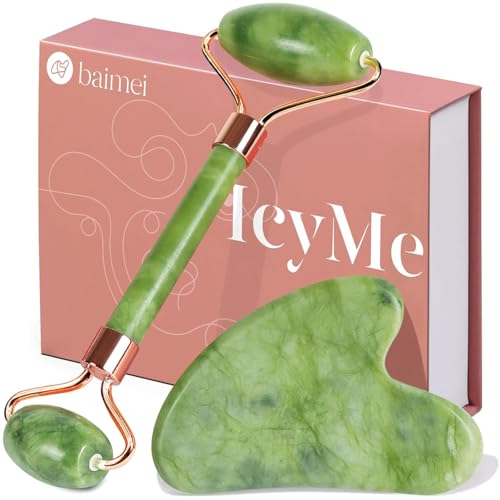
Best for: anyone who wants a roller for the cheeks and a stone for the jaw in one box. Skip it if: you already own a roller and just want the sculpting piece.
This is the pick to consider if you are starting from nothing and want both tools in one box. The two-piece set weighs 3.53 oz combined across 0.98 x 5.71 x 3.54 in of packaging, and BAIMEI says the jade can be chilled or frozen for extra puffiness relief. A jade roller does what a gua sha cannot: it handles the cheeks and forehead with a rolling motion, while the stone edge does the jawline pressing.
The set is the middle price of the six single-tool picks and the fastest seller of the six by a wide margin.
The trade-off is the same one every set makes. Neither tool in the box is as heavy or as durable as the Rena Chris or Kitsch steel pieces above. If you know you want the metal edge for jawline work, buy that separately and skip the roller. If you do not own either tool, the set gets you further for the money.
Pros:
- Two tools cover cheek rolling and jawline pressing
- Jade can be chilled for puffiness relief
- Sells faster than any other pick here
- Reinforced roller frame per BAIMEI
- Comes in a gift box
Cons:
- Neither piece is as heavy as the steel picks
- Roller adds cost you may not need
- Jade is porous and needs careful drying
- Roller mechanisms can loosen over time
5. PLANTIFIQUE Gua Sha Facial Tools — Best for pros
A 2.12 oz jade stone with a 3.19 x 1.97 x 0.2 in profile that lets an experienced user work precise strokes.

Best for: an experienced user who wants a slimmer, lighter stone for precise work. Skip it if: you want a heavier tool that does the pressing for you.
The PLANTIFIQUE is the lightest jade tool here after the Rena Chris budget stone, at 2.12 oz. It sits at a mid price point and its 0.2 in profile is thin for a stone, giving you an edge you can angle under the jaw without the bulk of a chunkier jade shape.
PLANTIFIQUE says the stone is authentic jade, handcrafted, and includes a usage guide. Those claims sit at the level of manufacturer copy: authenticity is not something the listing verifies with a certificate, so treat the material description as the seller's rather than a tested fact.
The reason this is the pick for a more practiced user is that a lighter tool demands more from the hand holding it. You have to know how much pressure to apply, and where. A heavier steel tool like the Rena Chris does more of that work for you. This is also the slowest seller of the six here, which is not a fault, but it does mean fewer people have made the same choice.
Pros:
- Slim 0.2 in profile for precise angles
- 2.12 oz keeps wrist fatigue low across long sessions
- Mid price for a jade stone
- Includes a usage guide
- Wide flat side works cheeks as well as jaw
Cons:
- Light weight means you supply more pressure
- Slowest seller in this set
- Porous stone needs regular cleaning
- Authenticity claim is the seller's, not certified
6. ANUA Collagen Retinol Refining Gua Sha Cream — Best premium
A neck cream with a W-shaped roller built into the cap, at the highest price in the set.

Best for: someone who wants the massage built into their neck cream, not a separate tool. Skip it if: you want a standalone tool you can chill in the fridge.
The ANUA is the odd one out in this comparison, and it earns its slot because the built-in roller changes the maths of jawline work. Instead of buying a gua sha and a serum separately, you get a 2.71 fl oz cream with a W-shaped massage head that ANUA says delivers a cooling sensation as it glides. The formula includes retinol capsules, collagen and peptides, dermatologically tested per the brand.
This is the most expensive pick here, and it is the only one where the tool and the product it works with come together.
There are three trade-offs. First, the tool is a roller, not an edge, so it will not hook under the jaw the way the steel plates above do. Second, you cannot chill the applicator in the fridge without chilling the entire cream, which changes the formulation. Third, when the cream runs out, so does the tool. As a jawline-and-neck routine in one purchase it works. As a pure gua sha, it is not really that.
Pros:
- Cream and applicator in one product
- W-shaped head sized for the jaw and neck
- ANUA states dermatological testing for sensitive skin
- The most stocked pick here, with more than one seller
- No separate tool to store
Cons:
- Highest price in the set
- Tool life is tied to the cream lasting
- Roller cannot hook under the jaw like a plate edge
- Cannot be chilled separately
Stone or steel: which edge sculpts a jawline better?
The stone-versus-steel argument is the one most gua sha guides start with, and it is worth settling before you buy.
Stone is warmer to hold, cooler on first contact, and glides softly across dry skin. The Rena Chris jade and the PLANTIFIQUE jade are both under 2.2 oz, which is the light end of the range. Stone also holds oils in its surface, which matters if you use it daily without cleaning it every time.
Steel is the opposite on every count. The Rena Chris and Kitsch steel plates both weigh a hair over 3.1 oz. Steel wipes clean with soap and water and stays cold across a full massage rather than warming in your hand. That last part is what makes it the better material for jawline work specifically. A cold tool moves lymphatic fluid; a room-temperature tool moves less.
The best gua sha for jawline sculpting in this set is a steel one for that reason, and the Rena Chris takes it because it matches the Kitsch on the numbers at a lower price.
Does the shape of the edge matter more than the material?
Yes, and this is the point most guides skip. A gua sha with only rounded oval edges is a cheek tool. A jawline tool needs one of three shapes:
- A concave curve deep enough to cup the mandible on a single stroke.
- A comb edge with teeth, for lifting along the jaw.
- A narrow taper for tucking under the ear.
Every pick in this comparison has at least one of those features on its edge. The steel plates from Rena Chris and Kitsch have the deepest concave curves at 0.13 to 0.16 in thick, which lets the edge sit flush against the bone rather than sliding across it. The PLANTIFIQUE jade is the slimmest stone here at 0.2 in, which gives you a similar hooking action from a lighter tool.
If you can only remember one thing before buying: hold the tool up in a mirror and check whether its longest curve matches the line of your jaw. If it does not, you will spend the session working against the shape rather than with it.
What the listings do not tell you about jawline work
Five things worth knowing that no product page in this set spells out:
- The tool is a lever, not a wand. Jawline definition comes from consistent lymphatic drainage over weeks, not one session. None of these pieces will change bone structure.
- Skin needs slip. Every tool in this set works with an oil or serum. Using a dry gua sha drags the skin and defeats the purpose. The ANUA solves this by being a cream. The others need one added.
- Angle beats pressure. A 30 to 45 degree tilt against the skin is what edges lift with. Pressing harder without changing the angle just presses harder.
- Direction matters. Jawline strokes travel from chin outward toward the ear, then down the side of the neck toward the collarbone. This is what actually moves the puffiness the listings promise.
- Chill it first if you can. Steel and stone both benefit from ten minutes in the fridge before use. This is a bigger difference than most people expect, and it is free.
How often should you actually use one?
Daily is possible with any of these tools, but it is not required. Three to five short sessions a week, two to five minutes per side, produces the same result over a month as a rushed daily habit. The tool matters less than the consistency of the practice, which is why a lighter beginner stone can serve you as well as a heavier steel plate as long as you actually use it. Rotate the tool through the fridge between sessions to keep the cold benefit.
The verdict
If you want a defined jawline and you are buying one tool, the Rena Chris stainless steel piece is the pick. Its 3.17 oz weight adds pressure your hand does not have to supply, its 0.16 in edge hooks under the mandible cleanly, and the steel stays cold across a full massage in a way stone cannot. It is also the second-cheapest of the six, which makes the choice easier than it usually is for a category winner.
The cutoff between the winner and the alternatives is one question: do you want a standalone tool, or a tool built into a cream? If standalone, the Rena Chris is the default and the Kitsch stainless steel is the upgrade if hygiene matters more than the difference in price. If built-in, the ANUA is the only pick here that combines the applicator with the product it works with, and it earns the premium slot for that reason. The BAIMEI set is the answer if you also want a roller. The PLANTIFIQUE and the Rena Chris jade sit at the light end for anyone who prefers stone in the hand.
FAQ
Is a metal or jade gua sha better for the jawline?
A metal or jade gua sha both work, but metal has the edge for jawline sculpting specifically. Stainless steel stays cold longer than jade, which helps move lymphatic fluid along the mandible. Jade feels softer against dry skin and is easier on the wrist because it is lighter. If you use oil or serum every session, steel wins on results. If you skip the slip, jade is kinder.
Is a gua sha worth it for jaw definition?
A gua sha is worth it for jaw definition if you accept it as a lymphatic tool rather than a bone-reshaping one. Consistent use over four to six weeks reduces puffiness along the jaw and neck, which is what most people mean when they say the jawline looks sharper. It will not change your underlying bone structure. Used two to five times a week with slip, it earns its place in a routine.
How much should a gua sha weigh for jawline work?
For jawline work, most tools in this comparison sit between 1.69 oz and 3.17 oz. Under 2 oz is a beginner or precision weight, where your wrist supplies the pressure. Around 3 oz is where the tool starts adding pressure on its own, which is what you want for the mandible. The Rena Chris and Kitsch steel plates both fall in that heavier range.
Rena Chris steel or Kitsch steel: which stainless piece wins?
The Rena Chris steel and Kitsch steel are almost identical on the numbers: 3.17 oz versus 3.14 oz, both stainless, both under 0.2 in thick. The Rena Chris is meaningfully cheaper. The Kitsch sells faster in this set and has a slightly thinner 0.13 in profile. If the price difference matters to you, take the Rena Chris. If it does not, the Kitsch is a fair upgrade on thinness alone.
What is the biggest mistake people make buying a gua sha for jawline?
The biggest mistake people make buying a gua sha for jawline sculpting is picking the tool by colour or stone type rather than by edge shape and weight. A pretty rose quartz oval with only rounded edges will not hook the mandible, no matter how much you spend on it. Check that the tool has a concave curve, a comb edge or a taper. That single feature decides whether it does the job.
Once you have the tool, the routine is simple. Chill it for ten minutes, apply a facial oil or serum, hold the edge at a 30 to 45 degree angle, and stroke from chin toward ear along the jaw, then down the side of the neck toward the collarbone. Three to five sessions a week, two to five minutes per side. Give it a month before you judge the result. The Rena Chris stainless steel is the tool I would put in most bathroom drawers for this, because it is heavy enough to work, cheap enough to try, and easy enough to clean that you will keep using it after the novelty passes.