Best Gua Sha for Hyperpigmentation: Rena Chris Wins

A ranked shortlist of seven gua sha tools for anyone building a routine around uneven skin tone, with the specifications that actually matter.

By Jessica TurnerUpdated 17 min read
On this page
- Best gua sha for hyperpigmentation at a glance
- How I screened these gua sha tools
- 1. Rena Chris Stainless Steel Gua Sha — Best overall
- 2. Rena Chris Jade Stone Guasha — Best budget pick
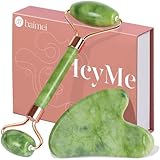
- 3. BAIMEI IcyMe Gua Sha & Jade Roller Set — Best for beginners
- 4. Ditind Jade Stone Gua Sha — Runner-up
- 5. PLANTIFIQUE Jade Gua Sha — Best for pros
- 6. Kitsch Stainless Steel Guasha — Best minimal setup
- 7. GEMELLE Lymphatic Gua Sha Face Oil — Best premium
- Can a gua sha really fade dark spots?
- Steel or jade: which suits pigmented skin?
- What to pair with your gua sha
- Mistakes that make pigmentation worse
- The verdict
- FAQ
The best gua sha for hyperpigmentation is the Rena Chris Stainless Steel Gua Sha, a 3.17 oz steel tool that stays cool on the skin and cleans with soap and water, both of which matter when you're working with pigment-prone areas. If you already own a stone and need a proper slip layer, GEMELLE Lymphatic Gua Sha Face Oil at 0.5 fl oz is the pairing that keeps friction low. What most buyers compare across gua sha listings is stone versus steel. That is not the question that actually decides it.
Best gua sha for hyperpigmentation at a glance
| Pick | Material | Weight | Price |
|---|---|---|---|
Best overall Rena Chris Stainless Steel Gua Sha |
Stainless steel | 3.17 oz | Check Price |
Best budget pick Rena Chris Jade Stone Guasha |
Jade stone | 1.69 oz | Check Price |
Best for beginners BAIMEI IcyMe Gua Sha & Jade Roller Set |
Jade (2 piece set) | 3.53 oz | Check Price |
Runner-up Ditind Jade Stone Gua Sha |
Jade (2 piece set) | 1.8 oz | Check Price |
Best for pros PLANTIFIQUE Jade Gua Sha |
Jade stone | 2.12 oz | Check Price |
Best minimal setup Kitsch Stainless Steel Guasha |
Stainless steel | 3.14 oz | Check Price |
Best premium GEMELLE Lymphatic Gua Sha Face Oil |
Face oil (0.5 fl oz) | not listed | Check Price |




How I screened these gua sha tools
I started with a wider list of gua sha listings and cut aggressively before ranking. The goal was a set where a shopper worried about uneven tone could actually choose between meaningful options, not a page of seven near-identical stones.
Three cuts did most of the work.
- Porous or unlisted materials went out first. Any listing that would not commit to a specific stone type or a food-grade steel grade got dropped. When you are massaging pigment-prone skin, a tool that will not name what it is made of is not a tool you want in the routine.
- Rough edges got cut. Gua sha is a scraping technique. A polished edge is non-negotiable. Every remaining listing describes a smooth or ultra-smooth surface in its own words.
- Weight had to be in a usable range. Anything above roughly 4 oz gets tiring on the face fast, and anything featherlight tends to skate off the oil. The seven survivors sit between 1.69 oz and 3.53 oz.
What survived is a mix that lets you pick by material, by count and by whether a roller belongs in the box. Two are steel, four are jade, one is a face oil that pairs with any of them. Two are two-piece sets. One is a premium pack, three sit at the entry position for price, and the remaining three fall between them.
I did not test these on skin. I compared the published specifications and the manufacturers' own descriptions side by side.
1. Rena Chris Stainless Steel Gua Sha — Best overall
Steel that stays cool, wipes clean, and weighs enough to work with real intention.
Best for: a beginner who wants one durable tool that stays cool on the skin Skip it if: you prefer the ritual and warmth of a natural stone
Steel is the answer nobody wants to hear in a category built on jade folklore, and it wins the top slot here for one reason: hygiene. The Rena Chris tool is 3.17 oz of stainless steel measuring 0.16 x 3.35 x 2.17 in, which is thin enough to angle under the cheekbone and heavy enough that it doesn't skid on oil. Rena Chris describes self-cooling properties as one of the material's advantages, and steel does hold its temperature longer than stone at room air. It's also the one buyers pick more often than most alternatives in this set, second only to BAIMEI on category sales rank.
For pigment-prone routines, the case for steel is the case against porous stone. Bacteria and old oil settle into rock, and you cannot fully sanitise a jade tool the way you can wipe a metal one. Anyone who has broken out along the jaw after a week of gua sha knows why that matters. The trade-off is aesthetic: steel feels clinical in the hand where jade feels like a ritual object. If that ritual is what gets you to use the tool consistently, buy stone. If the daily use is already there, buy this.
Pros:
- 3.17 oz gives a controlled, non-skidding glide
- Non-porous surface cleans with soap and water
- Thin 0.16 in edge for jaw and orbital bone
- Sells faster than most gua sha in this set
Cons:
- Loses the tactile appeal of stone
- Only one seller lists it
- Silver finish shows fingerprints readily
2. Rena Chris Jade Stone Guasha — Best budget pick
The cheapest of the seven, and the lightest, which changes what you use it for.

Best for: first-time buyers testing whether a daily gua sha routine sticks Skip it if: you want a heavier, more substantial tool in the hand
The jade version of Rena Chris weighs 1.69 oz, the lightest tool in this set, and measures 0.67 x 3.59 x 2.4 in. That is a thicker profile than the steel version by design: stone needs bulk to survive being dropped on a bathroom counter. The listing describes an ultra-smooth cool-touch surface and a wave-and-comb edge profile that lets you switch between long strokes on the cheek and finer scraping around the brow.
Practically, a lighter tool means more of the pressure comes from your hand. That is fine for beginners because it makes it harder to bruise yourself, and bruising is exactly what you want to avoid on skin that already flags any inflammation as new pigment. Rena Chris frames this as one of the entry points into the category, and the price position agrees: this is the cheapest of the seven and one of the smallest published weights, so what you're buying is a low-stakes way to find out whether the daily habit sticks.
Pros:
- Cheapest option in this set
- 1.69 oz reduces pressure-bruise risk
- Multiple edge shapes on one stone
- Ships in a gift-ready box
Cons:
- Porous stone can't be fully sanitised
- Feels insubstantial next to the steel picks
- The lightest weight here means slower work
3. BAIMEI IcyMe Gua Sha & Jade Roller Set — Best for beginners
A two-piece kit that lets a first-time user learn the strokes and cover the puffy days.
Best for: someone who wants a roller and a scraper in one box Skip it if: you already own a jade roller and only need the stone
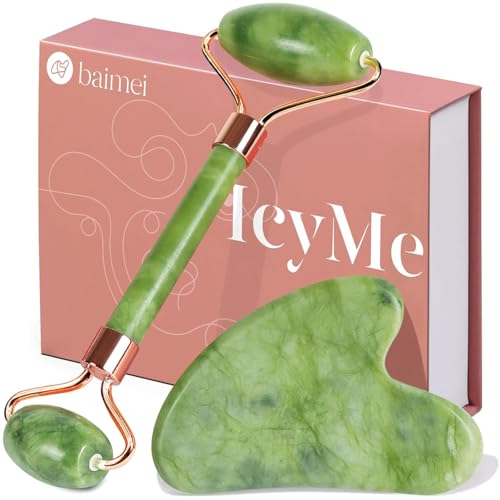
BAIMEI ships a 2-piece jade set weighing 3.53 oz combined, in a box measuring 0.98 x 5.71 x 3.54 in. The roller and scraper approach different jobs. A roller sweeps fluid down the neck and is friendly on inflamed skin because it doesn't drag. The scraper does the sculpting work along the jaw and cheekbone once things have calmed down. For someone who has never done gua sha, having both means you can start with the roller on tender days and graduate to the stone once you understand the pressure.
BAIMEI says the roller and stone can be chilled or frozen for extra puffiness relief, and jade holds cold reasonably well. It's also the one buyers choose most often in this set on category sales rank, which is worth noting but not worth over-reading. The trade-off is that a set costs more than a single tool of similar quality, and if you already own a roller you're paying for a piece you don't need. It also lands in the middle of this set for price, above both Rena Chris jade tools but below the premium picks.
Pros:
- Two tools cover gentle and sculpting work
- 3.53 oz combined is a workable everyday set
- Manufacturer says both pieces can be chilled
- Sells faster than the rest of this set
Cons:
- Redundant if you already own a roller
- Porous jade limits deep cleaning
- Larger box takes more counter space
4. Ditind Jade Stone Gua Sha — Runner-up
Two contoured pieces at 1.8 oz total, built for smaller zones the big stones can't reach.

Best for: targeting body areas and smaller facial zones like the nose sides Skip it if: you want one large stone that covers the whole face fast
The Ditind set weighs 1.8 oz across two jade pieces measuring 0.5 x 2.2 x 3.2 in. Ditind describes the smaller board as reaching trigger points and body areas the main stone can't cover comfortably, which is where this pick pulls its weight. If your pigmentation shows up in patches around the nose, above the lip or along the hairline, a smaller tool works those spots without dragging across surrounding skin.
Ditind's listing leans into full-body use, which is honest but not what most face-focused buyers are shopping for. Two sellers list it, one more than most tools in this set, so availability is slightly better. On category sales rank it sits behind the top picks here, and it lands at an entry price position among the seven. The compromise is straightforward: you get two focused tools instead of one substantial one, and if you prefer long sweeps down the cheek you'll find yourself picking up the larger piece and wondering why the smaller one shipped at all. Buy this if you already know you want a detail tool.
Pros:
- Two pieces for face and body coverage
- 1.8 oz total keeps pressure controllable
- Smaller piece reaches nose and mouth zones
- Two sellers stock it
Cons:
- Neither piece is large enough for full-cheek sweeps
- Porous jade limits sanitisation
- Slower category sales rank than the leaders here
5. PLANTIFIQUE Jade Gua Sha — Best for pros
A longer stone for someone who already knows the strokes and wants reach.

Best for: a confident user who wants a longer stone for cheek and neck sweeps Skip it if: you're brand new and want a shorter, easier-to-angle tool
PLANTIFIQUE's stone is 2.12 oz of jade at 3.19 x 1.97 x 0.2 in, with the listing noting a longer overall size of 6.5 x 2.5 x 0.5 in for the packaged product. The thin 0.2 in profile is unusual in this set: it's actively slim, closer to the steel picks than to the chunkier jade stones. That thinness matters because the edge is what does the work. A slim edge angles cleanly against the jaw and the trapezius without you having to twist your wrist.
PLANTIFIQUE describes the stone as handcrafted authentic jade and quality inspected for durability. Both are manufacturer claims, not verified specifications, and a stone that's this slim will crack if it hits a hard floor. The trade-off is skill. Longer, thinner tools reward users who have already learned how much pressure to use, and punish beginners who don't yet know where their own bones sit. It's also one of the more expensive picks in this set, so the return on investment only shows up if you use it often enough to notice the difference.
Pros:
- Slim 0.2 in edge for precise angles
- Longer profile suits full-cheek and neck sweeps
- 2.12 oz stays controllable through a long session
- Handcrafted stone with distinctive figuring
Cons:
- Thin stone is more fragile if dropped
- Slower category sales rank than smaller picks
- Higher price position without a warranty listed
6. Kitsch Stainless Steel Guasha — Best minimal setup
Steel again, in a thinner profile, for people who want one tool and nothing else.

Best for: anyone who prioritises hygiene and a thin, non-porous surface Skip it if: you want the traditional weight of stone in the hand
Kitsch matches Rena Chris on the material argument. It's 3.14 oz of stainless steel measuring 0.13 x 3.3 x 2.4 in, with a 0.13 in edge that's the thinnest published in this whole set. Kitsch calls the tool non-absorbent and easy to sanitise with soap and water, which is the same hygiene case Rena Chris makes. For pigment-prone skin that reacts to any leftover oil in a porous stone, that argument is the reason to consider steel at all.
Where this differs from the Rena Chris pick is price position and reach. Kitsch sits at the most expensive position in this seven-product set and is only stocked by one seller, both of which narrow the appeal. What you get for the extra spend, on published specifications, is a marginally thinner edge and a shorter overall length. Whether that's worth it depends on how strongly you feel about brand and finish. On the specifications alone, Rena Chris is the more sensible steel buy. Kitsch is here for buyers who want the minimal aesthetic and are willing to pay the position for it.
Pros:
- Thinnest 0.13 in edge in this set
- Non-porous steel wipes fully clean
- 3.14 oz gives balanced, controlled glide
- Cohesive minimal packaging
Cons:
- Most expensive pick here
- No stated warranty
- Only one seller lists it
7. GEMELLE Lymphatic Gua Sha Face Oil — Best premium
Not a stone, but the slip layer that decides whether any stone works safely.
Best for: someone who already owns a stone and needs the slip layer to use it safely Skip it if: you're only shopping for the tool itself
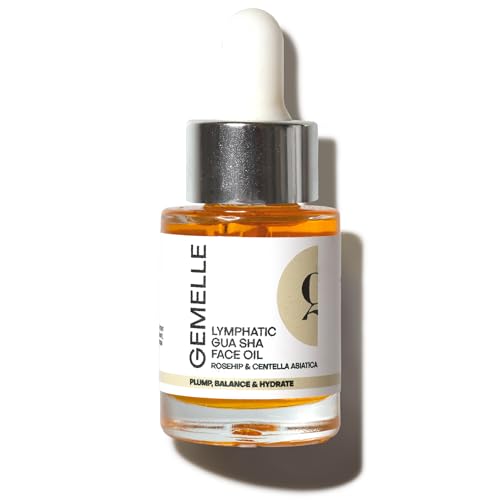
The odd one in the ranking, and included on purpose. GEMELLE's face oil ships at 0.5 fl oz in a 3.25 x 1.5 x 1.5 in bottle, and the brand describes it as designed for optimal glide with a stone or tool. Two sellers list it. This matters because the single biggest cause of pigmentation getting worse from gua sha is friction against dry skin. A stone dragged across dry skin creates microtrauma, and microtrauma on already-inflamed skin is what tips post-inflammatory hyperpigmentation from settled to spreading.
GEMELLE names its actives: rosehip and bakuchiol, described as a plant-based retinol alternative. Those are manufacturer claims and not something to build a treatment plan on, but bakuchiol has been discussed as a gentler alternative to retinoids for sensitive users. The real reason this pick belongs in the ranking is the friction question. It's the highest price position in this set and only 0.5 fl oz, so it costs a lot per drop. If you already own a good facial oil, use that. If you don't, buy this or something like it before you buy the stone.
Pros:
- Provides the slip layer any gua sha needs
- Named actives include bakuchiol and rosehip
- Compact 0.5 fl oz bottle travels easily
- Two sellers stock it
Cons:
- Highest price position in this set
- 0.5 fl oz runs out quickly with daily use
- Not a substitute for a gua sha tool
Can a gua sha really fade dark spots?
Here is the honest part of this guide. No gua sha tool has been shown to fade pigment on its own. Hyperpigmentation, whether it comes from sun damage, hormones or the aftermath of acne, is a pigment issue in the deeper skin layers. A stone or a steel scraper cannot reach that layer, and no listing in this set claims otherwise. The manufacturers describe circulation, lymphatic drainage, puffiness relief, jawline sculpting and tension release. None of them claim pigment correction.
What a gua sha can do, used correctly, is support the routine that actually treats pigmentation. It improves circulation, which helps active ingredients move through the skin. It gives you a reason to slow down and apply serum properly instead of slapping it on. And if you use it with a good oil, it stops you tugging at skin that reacts to friction.
Used incorrectly, it makes pigmentation worse. Pressure hard enough to leave redness will leave pigment too, on skin that's prone to it. So the tool matters less than the technique.
Steel or jade: which suits pigmented skin?
This is where the set actually splits. The seven picks divide into two steel tools, four jade tools and one oil, and the choice between steel and jade has real consequences for pigment-prone routines.
Steel wins on hygiene. Both steel picks describe non-porous surfaces that clean fully with soap and water. Jade is a stone, so it holds oil and bacteria in the surface at a microscopic level, and no amount of wiping removes that entirely. For anyone whose pigmentation follows breakouts, hygiene is the single most controllable variable.
Jade wins on temperature ritual. Jade can be chilled in the fridge and holds cold for a workable session. Steel cools too, but it warms faster in the hand. If your pigmentation flares with heat, that afternoon chill from a fridge-stored stone is a real benefit.
Weight decides pressure. The heavier the tool, the less you have to press. The lightest tool here is 1.69 oz and the heaviest single piece is 3.17 oz. For pigment-prone skin, heavier is generally safer, because your hand does less work and applies less variable pressure. The steel picks lean into this. The lightest jade stones ask more of the user.
The steel-versus-jade debate is not actually about which is better. It's about which one fits the routine you already have. If you already sanitise your tools with soap and water and want to keep doing that, buy steel. If you already keep a stone in the fridge for morning depuffing, buy jade.
What to pair with your gua sha
A gua sha tool used without a slip layer is a scraper on dry skin, and dry skin is where pigmentation trouble starts. Every listing here that talks about technique mentions oil or serum. That is not optional.
Three things to keep on the counter next to the tool:
- A facial oil that suits your skin type. The GEMELLE pick lists bakuchiol and rosehip; you can use anything similar. What matters is a continuous glide film, not the brand.
- A clean cloth for the tool. Wipe the stone after every use. If it's steel, warm soapy water twice a week.
- A mirror at natural light. Working in shadow means over-pressing on the spots you can't see clearly.
For actual pigment correction, that's a conversation for a dermatologist, not a gua sha guide. But the tool works better when it sits inside a routine that already includes sunscreen, a targeted serum and consistent sleep. On its own it's a nice ritual. Inside a routine, it earns its place.
Mistakes that make pigmentation worse
Three mistakes come up often enough to name.
- Pressing too hard. If you see redness that stays for more than a few minutes, you pressed too hard. On pigment-prone skin, that redness can convert to new pigment. Use the weight of the tool, not the strength of your hand.
- Skipping the oil. Dry skin plus stone equals friction burn. Friction plus melanocyte activity equals darker spots. This is not a theoretical risk; it is the mechanism.
- Working over active breakouts. A gua sha across an inflamed pimple drags bacteria across surrounding pores and forces the papule further into the skin. Both are how post-inflammatory pigmentation gets seeded. Route around anything active.
The other mistake is expecting fast results. Gua sha is a low-intensity daily practice. If it works for you at all, it works over months, not days. Anyone promising visible pigment change in a week is selling something that isn't in this set.
The verdict
If you are shopping the seven picks in this set, buy the Rena Chris Stainless Steel Gua Sha. Steel is the material that fits a pigment-prone routine best because it cleans fully, holds a controlled 3.17 oz weight, and doesn't harbour the leftover oil that porous stone does. It's also priced at an entry position and sells faster than most alternatives in this set, so availability is dependable.
The two-track answer works like this. If your priority is hygiene and daily consistency, the Rena Chris steel tool is the pick. If your priority is temperature ritual and the tactile experience of stone, the BAIMEI IcyMe Set is the better buy because the roller lets you skip pressure entirely on inflamed days. The cutoff between them is whether your pigmentation gets worse with heat: if it does, the chilled jade set of BAIMEI has a real functional advantage over steel that warms in the hand.
For anyone who already owns a stone, add the GEMELLE face oil before anything else. The slip layer decides whether a gua sha helps your skin or aggravates it, and no tool corrects for the absence of oil.
FAQ
Is a gua sha worth it for hyperpigmentation?
Is a gua sha worth it depends on what you expect. It will not fade pigment on its own; no listing in this set claims that, and no tool at this price could. What it can do is improve circulation, support the delivery of the serums that actually treat pigment, and slow your routine down. Bought as one part of a broader plan, yes. Bought as a standalone treatment, no.
Which gua sha is easiest to keep clean?
Which gua sha is easiest to keep clean is a two-tool question. Both stainless steel picks, the Rena Chris and the Kitsch, describe non-porous surfaces that clean fully with soap and water. Jade is a stone, so it holds oil at a microscopic level and cannot be sanitised the same way. If breakouts feed your pigmentation, hygiene matters, and steel is the more sensible material.
How does the Rena Chris steel compare to the Kitsch steel?
The Rena Chris steel compares to the Kitsch on two specifications. Rena Chris is 3.17 oz with a 0.16 in edge; Kitsch is 3.14 oz with a 0.13 in edge. Practically identical in the hand. Where they part is price: Kitsch sits at a premium position in this set while Rena Chris sits at an entry position. On specifications alone, Rena Chris is the better buy.
Do I need to use oil with a gua sha?
Do I need to use oil is the wrong question. You need something to reduce friction: an oil, a serum with slip, or a rich moisturiser. Without it, the tool drags across dry skin and creates the microtrauma that can worsen pigmentation on prone skin. The GEMELLE oil in this ranking is one option; any facial oil with a smooth glide will do the same job.
Can gua sha make dark spots worse?
Can gua sha make dark spots worse, yes, if used incorrectly. Pressing hard enough to leave redness is the same mechanism that can leave pigment on melanin-rich skin, called post-inflammatory hyperpigmentation. Using a stone without a slip layer, or working directly over active breakouts, both create the inflammation that seeds new spots. The tool is safe when the technique respects those limits.
If you want one thing to do next, buy the steel tool and a small bottle of any facial oil you already trust. Start with two minutes a night, on freshly cleansed skin, with more oil than you think you need. Use the flat edge, not the point, and stop the moment you see redness that doesn't fade in under a minute. The point of a gua sha in a hyperpigmentation routine is not to correct pigment. It is to add a slow, low-intensity habit that stops you rushing everything else, and Rena Chris makes the steel version of that habit as durable and hygienic as any tool in this category.