Best Exfoliating Toner for Acne Scars on a Budget
A spec-by-spec look at seven exfoliating toners, from 2% salicylic acid liquids to 70-count peeling pads, with the acid blend that matters for texture and the honest limits on what a toner can do for marks.

By Jessica TurnerUpdated 19 min read
On this page
- Best exfoliating toner for acne scars at a glance
- What an exfoliating toner can and can't do for scars
- How I cut the field down to seven
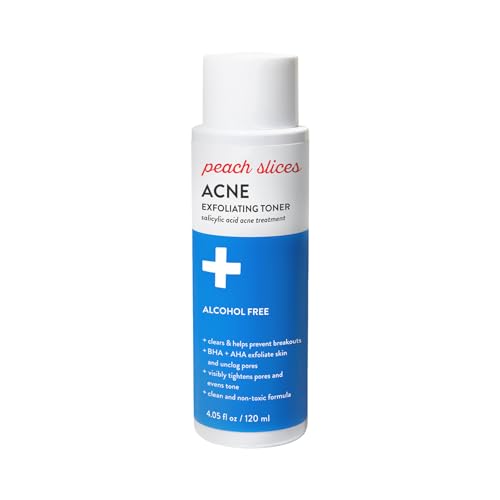
- 1. Peach Slices - Acne Exfoliating Toner — Best overall
- 2. medicube Toner Pads Red Succinic Acid — Best upgrade
- 3. The Ordinary Saccharomyces Ferment 30% Milky Toner — Runner-up
- 4. SOME BY MI AHA BHA PHA 30 Days Miracle Toner — Most versatile
- 5. CeraVe BHA Exfoliating Facial Toner — Best for pros
- 6. La Roche-Posay Effaclar Clarifying Solution — Best minimal setup
- 7. Clinique Acne Solutions Clarifying Lotion — Best premium
- Liquid or pad: which format suits your routine?
- What does the extra money actually buy here?
- How long does one bottle last?
- What the listings won't tell you
- The verdict
- FAQ
The best exfoliating toner for acne scars is the Peach Slices Acne Exfoliating Toner, because it stacks salicylic, glycolic and lactic acid into one 4.05 oz bottle at the lowest price position in this set. If your skin flushes at strong acids, the medicube Red Succinic Acid pads give you 70 pre-dosed sweeps at a gentler pH instead.
Here's the shortlist in 30 seconds. Peach Slices for oily breakout-prone skin, medicube pads if you want the exfoliation portioned out for you, and The Ordinary's milky toner if your skin is dry and reactive but you still want texture work.
Best exfoliating toner for acne scars at a glance
| Pick | Key acids | Size | Price |
|---|---|---|---|
Best overall Peach Slices Acne Exfoliating Toner |
2% salicylic glycolic + lactic |
4.05 fl oz | Check Price |
Best upgrade medicube Red Succinic Acid Toner Pads |
succinic + salicylic + glycolic claim | 70 count | Check Price |
| 30% yeast ferment + NAG | 3.4 fl oz | Check Price | |
Most versatile SOME BY MI AHA BHA PHA 30 Days Miracle Toner |
AHA + BHA + PHA claim 2% niacinamide |
5.07 fl oz | Check Price |
Best for pros CeraVe BHA Exfoliating Facial Toner |
salicylic + niacinamide 3 ceramides |
8 fl oz | Check Price |
Best minimal setup La Roche-Posay Effaclar Clarifying Solution |
0.5% salicylic + glycolic | 6.76 fl oz | Check Price |
Best premium Clinique Acne Solutions Clarifying Lotion |
salicylic, alcohol-free 1.0 option | 6.7 fl oz | Check Price |




What an exfoliating toner can and can't do for scars
Time for the uncomfortable part. Not one of these seven listings claims to treat scars, and I'm not going to pretend otherwise on their behalf.
"Acne scar" gets used for two very different things. The flat brown or pink marks left behind after a spot clears are post-inflammatory pigmentation and erythema, and they fade with time, sun protection and cell turnover. Indented or raised scars are structural changes in the dermis, and no liquid you sweep on with a cotton pad rebuilds collagen down there.
What an exfoliating toner for acne scars can plausibly do sits in the first category. Two of these listings speak to it directly. The Ordinary says its 30% ferment formula was clinically tested to reduce the appearance of dark spots, and CeraVe's niacinamide claim is about visibly balancing skin tone. Everything else here is written around pores, oil and texture.
So set your expectations by mechanism, not marketing:
- Regular gentle exfoliation keeps dead cells moving, which is how surface marks look less entrenched over weeks.
- Fewer new breakouts means fewer new marks, which is the most reliable win a toner delivers.
- Niacinamide and ferment ingredients target tone, not depth.
- Nothing here fills an indent. For that you're in dermatology territory, not toner territory.
Judge these bottles as prevention and surface-smoothing tools. That framing is honest, and it's also the framing that actually gets results.
How I cut the field down to seven
Three disqualifications did most of the work before I compared anything.
Cut one: no exfoliating actives. Plenty of products in the toners and astringents category are hydrating mists with a splash of botanicals. If a listing didn't name an acid, a ferment or an enzyme doing the exfoliating, it was out. Every survivor names its mechanism.
Cut two: no published size. A toner is a consumable, and a bottle you can't size is a bottle you can't plan around. Six of these seven publish a fluid ounce figure and the seventh publishes a 70-count pad number, so all seven let you work out how long the jar lasts.
Cut three: single-purpose actives with no support ingredient. A raw acid with nothing soothing alongside it is a recipe for a compromised barrier, and a compromised barrier makes marks look worse, not better. Every pick here pairs its exfoliant with something else: allantoin and cucumber in the Peach Slices, panthenol in the medicube pads, ceramides in the CeraVe, squalane in The Ordinary.
What survived spans a real range. Prices run from the cheapest of the seven to the most expensive, sizes run from 3.4 fl oz up to 8 fl oz, and formats split into liquids and pads. The medicube pads sell faster than anything else in this group by a wide margin, and the CeraVe is the slowest seller here, which is what you'd expect from a formula listed as released in 2026.
1. Peach Slices - Acne Exfoliating Toner — Best overall
Three acids in a 4.05 oz bottle at the lowest price position here, which is the most exfoliation per dollar in this group.
Best for: oily, breakout-prone skin that wants three acids in one step Skip it if: your skin stings at 2% salicylic acid
What separates this from the rest of the set is the printed number. Peach Slices states 2% salicylic acid, and adds glycolic and lactic acid on top. Compare that to the La Roche-Posay listing at 0.5% salicylic, and you're looking at a fourfold difference in the one figure both brands chose to publish. For clogged pores and the rough texture that comes with them, that gap matters.
The brand describes it as step 2 of a three-step acne system, so the formula is built to sit between a cleanser and an oil-free moisturiser rather than carry a routine alone. Peach Slices says the acid blend targets breakouts without over-drying, and lists cucumber, acerola and allantoin as the soothing side of the formula. Those are claims from the listing, not measured results.
At 4.05 fl oz it's the second-smallest bottle here, beaten only by The Ordinary's 3.4 fl oz. That's the trade-off for the price position. You get the strongest published acid figure in the group in the least amount of product, so heavy daily users will restock sooner than someone on the 8 fl oz CeraVe.
Pros:
- Lowest price position of all seven picks
- Only pick naming a 2% salicylic acid figure
- Three acid types in one step
- Allantoin and cucumber listed as soothing agents
- Compact 1.61 x 5.39 x 1.61 in bottle
Cons:
- Second-smallest volume in the set at 4.05 fl oz
- 2% salicylic is too strong for reactive skin
- Designed as one part of a three-step system
- No stated warranty or satisfaction terms
2. medicube Toner Pads Red Succinic Acid — Best upgrade
Seventy pre-soaked pads that portion your exfoliation for you, and the fastest seller in this entire group.

Best for: anyone who wants a pre-dosed pad and a physical sweep Skip it if: you travel light or hate single-use waste
The format is the story. Every other pick asks you to decant liquid onto a cotton pad and guess at the dose, which is exactly how people over-exfoliate. Seventy pads means seventy identical applications, and a textured pad adds light physical sweeping on top of the chemical work.
medicube lists succinic acid, salicylic acid and glycolic acid together, with panthenol and niacinamide as the soothing pair. The listing also claims a skin-friendly pH of 3.5 to 5.5 and says the pads are dermatologist-tested and clinically proven non-irritating. Those are the manufacturer's claims. What I can verify from the data is the position: this is the second-most expensive pick here and by far the quickest mover in the set, which tells you buyers keep choosing it.
The jar measures 3.43 x 3.98 x 3.54 in and weighs 0.66 lb, so it's a squat, chunky thing on a shelf. Not a travel product. And per application you're paying a premium over any liquid here, because the pad is part of what you're buying. That's the honest cost of convenience.
Pros:
- 70 pre-dosed pads remove all guesswork on dose
- Physical sweep plus chemical acids in one step
- Panthenol and niacinamide named as soothing agents
- Fastest-moving pick of the seven
- pH of 3.5 to 5.5 stated on the listing
Cons:
- Second-highest price position in this set
- Bulky 0.66 lb jar is awkward for travel
- Pads create disposable waste every use
- Runs out at a fixed 70 uses with no top-up option
3. The Ordinary Saccharomyces Ferment 30% Milky Toner — Runner-up
The only pick here that does its exfoliating without an acid, and the only one whose listing mentions dark spots and clinical testing together.
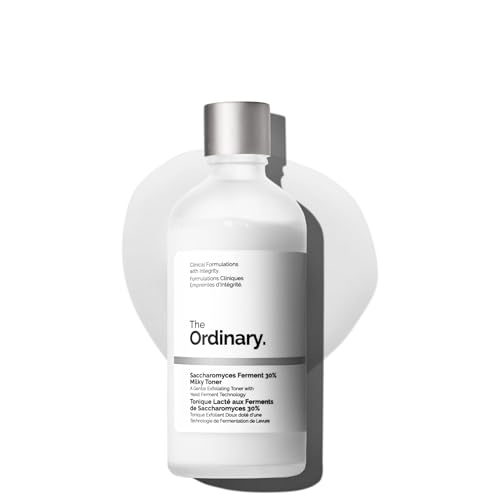
Best for: dry or reactive skin chasing brightness without strong acids Skip it if: you need salicylic acid for clogged pores
This is the outlier, and that's why it earns a high spot. Instead of glycolic or salicylic acid, the formula runs on 30% yeast ferment plus N-Acetylglucosamine. For anyone whose skin has already been burned by an acid toner, that's a genuinely different route to smoother texture.
For the marks specifically, this listing goes further than the others. The Ordinary says the formula is clinically tested to reduce the appearance of dark spots and improve overall brightness, and adds squalane for barrier support. It's positioned as suitable for sensitive and dry skin. Again, brand claims, but they're the most on-point claims in the group for post-acne pigmentation rather than pores.
The texture is a lightweight emulsion, milky rather than watery, which some people find leaves a faint film under sunscreen. At 3.4 fl oz it's the smallest bottle here despite weighing 7.04 oz on the scale, and it's the second-cheapest pick.
The catch is what it doesn't do. No BHA means no oil-soluble action inside a clogged pore. If active breakouts are your main issue, this is the wrong tool and the Peach Slices is the right one.
Pros:
- Only acid-free exfoliating route in this set
- Listing cites clinical testing on dark spot appearance
- Squalane included for barrier support
- Second-cheapest of the seven picks
- Suitable for dry and sensitive skin per the brand
Cons:
- No salicylic acid, so limited on clogged pores
- Smallest volume here at 3.4 fl oz
- Milky emulsion can feel heavy under sunscreen
- Weakest fit if active acne is the main concern
4. SOME BY MI AHA BHA PHA 30 Days Miracle Toner — Most versatile
Three acid families in one bottle plus 2% niacinamide, at the third-cheapest price position in this group.

Best for: combination skin that wants one bottle for the whole face Skip it if: you want acid percentages printed on the box
PHA is the differentiator here. Polyhydroxy acids have larger molecules than glycolic acid, which generally means slower, gentler surface work, and no other pick in this set names one. Pairing it with AHA and BHA gives you coverage across dry patches, oily zones and clogged pores from a single bottle, which is why combination skin does well with it.
SOME BY MI also states 2% niacinamide, making this the only pick with a printed niacinamide figure. Niacinamide is the ingredient most often discussed for evening skin tone, so its presence at a stated strength is worth noting for anyone thinking about post-acne marks rather than just spots.
At 5.07 fl oz and 7.05 oz on the scale, it's mid-sized here, in a tall 6.3 x 0.98 x 0.98 in bottle that's narrow enough to fit a crowded shelf. Model SBM3661 if you're cross-checking.
What's missing is precision. The listing names AHA, BHA and PHA without giving a percentage for any of them, so you can't compare its exfoliating strength against the Peach Slices at 2% salicylic or the La Roche-Posay at 0.5%. You're trusting the blend rather than reading the numbers.
Pros:
- Only pick naming a PHA alongside AHA and BHA
- 2% niacinamide stated on the listing
- Third-cheapest of the seven
- Slim 0.98 in diameter bottle saves shelf space
- Suits combination skin across the whole face
Cons:
- No percentage published for any of the three acids
- Marketing language is vague on measurable outcomes
- Tall bottle tips easily on a narrow ledge
- Nothing in the listing addresses marks directly
5. CeraVe BHA Exfoliating Facial Toner — Best for pros
Eight fluid ounces, the largest bottle here, with three ceramides built in for people already running strong actives.

Best for: barrier-first routines already running a retinoid Skip it if: you want a track record rather than a brand-new formula
Volume first: 8 fl oz beats every other pick, nearly two and a half times The Ordinary's 3.4 fl oz. If you exfoliate daily and treat your neck and chest as well as your face, that difference is weeks of extra use, and it sits at a mid-range price position rather than a premium one.
The formula reasoning is why I've flagged it for experienced users. CeraVe pairs salicylic acid with three ceramides, hyaluronic acid and niacinamide, which is a deliberate attempt to exfoliate and reinforce the barrier in the same step. If you're already on a retinoid or a benzoyl peroxide wash, the barrier support is the part that stops the whole routine tipping into irritation. The brand claims 95% agreed texture looked smoother in one week and describes the texture as a liquid-gel that absorbs without shine.
Two caveats. The listing shows a release year of 2026, so this is the newest formula in the set with the least history behind it, and it's the slowest seller of the seven. Neither is a flaw in the product, but a brand-new launch gives you less to go on than a formula that's been on shelves for a decade.
Pros:
- Largest volume here at 8 fl oz
- Three ceramides plus hyaluronic acid for barrier support
- Niacinamide included for redness and tone
- Mid-range price position for the biggest bottle
- Liquid-gel texture claimed to absorb without shine
Cons:
- Newest formula in the set, listed as a 2026 release
- Slowest seller of all seven picks
- Salicylic percentage not published
- Fewest published specifications of any pick here
6. La Roche-Posay Effaclar Clarifying Solution — Best minimal setup
A stated 0.5% salicylic acid, the mildest published acid figure here, for skin taking its first steps into exfoliation.

Best for: sensitive skin easing into acids with one product Skip it if: you need serious exfoliation from a single step
The low number is the feature, not a shortfall. At 0.5% salicylic acid with glycolic acid alongside, this is a quarter of the salicylic strength the Peach Slices publishes. For skin that has reacted badly to acids before, starting a quarter of the way up the ladder is the sensible move.
La Roche-Posay names the concerns it targets: red raised pimples, blackheads, whiteheads, clogged pores, enlarged pores, uneven texture and sensitive skin. The listing calls glycolic acid the gold standard for exfoliation in dermatology, which is the brand's framing rather than a verified verdict on this particular formula.
Practical details are solid. It's 6.76 fl oz, the second-largest bottle here, at 8 oz total weight in a 6.7 x 1.8 x 1.8 in bottle. Model Setaf_mx_216, listed as released in 2015, so it has a decade behind it. That longevity is a real reassurance the CeraVe can't offer.
The problem is what you pay for the gentleness. This sits at the second-highest price position in the set while delivering the weakest published acid strength, and it holds no niacinamide, no ceramides and no pigmentation claim. Gentle and expensive is a specific combination, and only some buyers want it.
Pros:
- Gentlest published acid strength at 0.5% salicylic
- Second-largest bottle here at 6.76 fl oz
- Glycolic acid alongside the salicylic
- Listed as released in 2015, a long track record
- Names sensitive skin among its target concerns
Cons:
- Second-highest price position for the mildest acid figure
- No niacinamide, ceramides or ferment ingredients
- Too weak to be a standalone exfoliant for oily skin
- Nothing in the listing addresses tone or marks
7. Clinique Acne Solutions Clarifying Lotion — Best premium
The only pick offering an alcohol-free variant built specifically for sensitive and very dry skin.
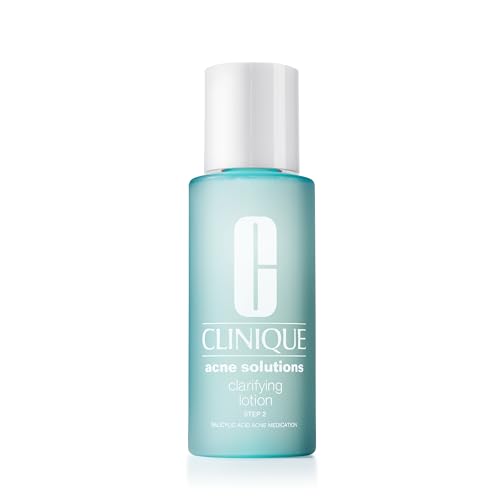
Best for: very dry or sensitive skin that wants an alcohol-free option Skip it if: you want the acid strength spelled out
The tiering is what nothing else here does. Clinique says the clarifying lotion comes in five formulas tailored by skin type, with 1.0 described as an extra-gentle alcohol-free formula for sensitive skin and 1 described as mild for very dry skin. Every other pick in this comparison is one formula for everyone.
Alcohol content is a live issue for anyone dealing with post-acne marks, because a drying formula can leave skin flushed and make discolouration read as more obvious than it is. Having a route that removes alcohol from the equation is genuinely useful, and no other listing here offers one.
The application method is old-school. Clinique describes sweeping it over skin with a cotton ball to lift pollution, dirt, impurities and excess oil, and says skin-buffering ingredients keep it comfortable. It's a 6.7 fl oz bottle at 6.7 x 1.9 x 2 in, model 6K0G011000, listed as released in 2024.
Now the hard part. This is the most expensive pick of the seven and the vaguest on numbers: salicylic acid appears in the title with no percentage anywhere. You're paying the top price in this set for the least quantified formula in it, and choosing the right variant number off a shelf is its own small hurdle.
Pros:
- Only pick with an alcohol-free formula variant
- Five formulas tailored to different skin types
- Skin-buffering ingredients named on the listing
- 6.7 fl oz, a generous everyday volume
- Listed as released in 2024
Cons:
- Highest price position of all seven picks
- No salicylic acid percentage published anywhere
- Variant numbering makes ordering easy to get wrong
- Cotton-ball application wastes product
Liquid or pad: which format suits your routine?
Format decides consistency, and consistency decides results. Here's how the two split.
Liquids put you in charge of the dose. Six of the seven picks are liquids, and volumes run from 3.4 fl oz to 8 fl oz. You can apply with hands to save product, or with a cotton pad for a light physical sweep. The risk is drift: a generous pour on a bad-skin day is how a gentle toner becomes an over-exfoliating one.
Pads remove the decision. The medicube jar holds 70 pre-soaked pads, so each application is identical and you always know how many are left. The cost is per-use price and a bulky 0.66 lb jar that doesn't travel.
Match the format to how you actually behave:
- You forget or rush your routine. Pads. Grab, sweep, done.
- You share a bathroom shelf with three other people. The SOME BY MI bottle is 0.98 in wide.
- You treat neck and chest too. The 8 fl oz CeraVe, no contest.
- You've over-exfoliated before. Pads, for the fixed dose.
- You want the lowest cost per use. A liquid, every time.
What does the extra money actually buy here?
Not more acid. That's the finding that surprised me most while lining up the published figures.
The cheapest pick in this comparison, the Peach Slices, publishes the strongest acid figure at 2% salicylic. The second-most expensive liquid, the La Roche-Posay, publishes 0.5%. The most expensive pick of all, the Clinique, publishes no percentage at all. If raw exfoliating strength is what you're after, spending more actively works against you here.
So what does more money buy?
- Formulation options. Clinique's five skin-type variants and the alcohol-free 1.0 route exist nowhere else in this set.
- Convenience. The medicube pads charge for the pad, the pre-soaking and the fixed dose.
- Gentleness with brand backing. La Roche-Posay charges for a decade-old formula pitched squarely at sensitive skin.
- Volume, occasionally. The mid-priced CeraVe at 8 fl oz is the exception, buying you the most product in the set.
At the entry positions you get the Peach Slices, The Ordinary and the SOME BY MI, and between those three you can cover strong acids, acid-free exfoliation and a three-acid blend. That's most of the useful range in this category, at the bottom of it.
How long does one bottle last?
Do this arithmetic before you buy, because it changes the value picture more than the price position does.
Sizes here run 3.4, 4.05, 5.07, 6.7, 6.76 and 8 fl oz, plus the 70-count pad jar. Twice-daily use on a face burns through liquid roughly twice as fast as once-daily use, and adding neck and chest speeds it up again.
The pad jar is the only pick with an exact answer. Seventy pads is 70 uses at once a day, or 35 at twice a day, and the number on the label doesn't move. Everything else depends on your hand.
Two habits stretch a bottle noticeably. Apply with clean fingertips rather than a cotton pad, since cotton absorbs a meaningful share of what you pour. And build up gradually: three nights a week before daily use is both gentler on your barrier and kinder to the bottle. A slow ramp is also how you find out whether 2% salicylic suits you before you've committed to finishing 4.05 fl oz of it.
What the listings won't tell you
Three gaps run through all seven of these product pages, and knowing them changes how you read any exfoliating toner for acne scars listing.
Percentages go missing when it suits. Only two picks publish a salicylic acid figure. The other five name acids without strength, which means you cannot rank them against each other on potency. Treat an unquantified acid list as a description of the approach, not a measure of the power.
Nobody publishes a full ingredient list on the front of the listing. Fragrance, alcohol and preservative choices matter for reactive skin, and the only reason I can tell you Clinique has an alcohol-free variant is that Clinique chose to say so. Check the label image or the manufacturer's page before you commit.
"Clinically tested" is doing a lot of unspecified work. The Ordinary cites clinical testing on dark spot appearance, medicube cites dermatologist testing for non-irritation, and CeraVe cites a 95% agreement figure on texture. Each is the brand's own summary of its own study, with no sample size, duration or protocol on the listing. They're worth something. They're not worth the same as an independent trial.
The verdict
The Peach Slices Acne Exfoliating Toner wins because it publishes the strongest acid figure in this group, 2% salicylic supported by glycolic and lactic acid, while sitting at the lowest price position of all seven. For breakout-prone skin trying to stop new marks forming, that combination is hard to argue with, and 4.05 fl oz is enough to find out whether the blend suits you without a large commitment.
Two conditions flip it. If your skin has reacted badly to acids before, buy the medicube Red Succinic Acid pads instead. Seventy pre-dosed pads at a stated pH of 3.5 to 5.5 make over-application almost impossible, and that's the single biggest cause of the redness people mistake for a bad formula. If your main concern is existing discolouration rather than active spots, The Ordinary's milky toner is the better fit, because its 30% ferment formula is the only one here whose listing puts dark spot appearance at the centre of the claim, and its squalane content suits dry skin the acids would aggravate.
The runner-up's specific advantage over the winner is that it exfoliates without a single acid in the formula. That's not a small thing. It means one entire category of irritation risk simply doesn't apply, and for anyone who has already failed with salicylic acid, it's the difference between a routine they can keep and one they abandon in a fortnight.
FAQ
Is an exfoliating toner worth it for acne scars?
An exfoliating toner is worth it for surface concerns, with realistic expectations. Regular gentle exfoliation supports cell turnover, and fewer new breakouts means fewer new marks. Flat post-acne discolouration can look better over weeks. Indented or raised scarring is a dermal structural change, and no toner reaches that depth. Buy one for prevention and texture, not for filling indents.
What's the cheapest exfoliating toner for acne scars in this set?
The cheapest exfoliating toner for acne scars here is the Peach Slices, which also happens to publish the strongest acid figure at 2% salicylic. The Ordinary sits at the second-cheapest position and the SOME BY MI third. Between those three you can cover strong acids, acid-free ferment exfoliation and a three-acid blend, which is most of the useful range in this category.
How much salicylic acid should an exfoliating toner have?
How much salicylic acid you need depends entirely on your tolerance. Two picks here publish figures: Peach Slices at 2% and La Roche-Posay at 0.5%. Start at the lower end if your skin flushes easily or you've reacted to acids before. Oily skin with persistent clogged pores generally handles the higher figure. Use three nights a week before you go daily.
Peach Slices or medicube pads: which should I pick?
Peach Slices or medicube comes down to dose control against acid strength. Peach Slices gives you 2% salicylic plus glycolic and lactic acid in a 4.05 fl oz bottle at the lowest price position. The medicube jar gives you 70 pre-soaked pads at a stated pH of 3.5 to 5.5, sitting near the top of the price range. Choose pads if you over-apply liquids.
What mistake do people make with an exfoliating toner?
The mistake people make with an exfoliating toner is going daily immediately, then blaming the formula when skin turns red and tight. A damaged barrier makes discolouration look worse, not better. Ramp up over three weeks, use sunscreen daily since exfoliated skin pigments more readily, and never stack a strong acid toner with a retinoid on the same night.
Start with the Peach Slices and one habit alongside it: daily sunscreen. Acids and sun exposure work against each other, and skipping the second undoes most of what the first achieves on post-acne marks. Three nights a week for the first fortnight, then judge. If your skin stays calm, move to nightly. If it doesn't, the medicube pads at a fixed dose or The Ordinary's acid-free route are both waiting, and neither asks you to gamble on a large bottle. The best exfoliating toner for acne scars is the one you're still using in three months.