Best Exfoliating Toner for Teens With Oily Skin

A glycolic bottle, a salicylic liquid, and a jar of 70 pads all promise smoother skin. Here's which format suits a teenage routine, what the acid percentages actually mean, and when to pick pads over liquid.

By Jessica TurnerUpdated 15 min read
On this page
- Best exfoliating toner for teens at a glance
- How I narrowed this down to five toners
- What does the acid on the label actually do?
- 1. The Ordinary Glycolic Acid 7% Exfoliating Toner — Best overall
- 2. medicube Toner Pads Red Succinic Acid Panthenol Pad — Best premium
- 3. Peach Slices Acne Exfoliating Toner — Best upgrade
- 4. MAREE Exfoliating Toner with Salicylic Acid — Best minimal setup
- 5. Avatara Kombucha The Clean Sweep Face Toner — Best budget pick
- Pads or liquid: which format suits a teen routine?
- How long does one bottle last?
- What these listings do not tell you about teen skin
- The verdict
- FAQ
The best exfoliating toner for teens is The Ordinary Glycolic Acid 7% Exfoliating Toner, a 3.4 fl oz bottle with a single named acid at a stated strength. If you'd rather not pour and guess, medicube's Red Succinic Acid pads hand you 70 pre-soaked doses instead. Both live in the same aisle and solve the same problem in completely different ways.
Money buys three different things here. The two entry picks give you one acid in a plain bottle. The mid-range option stretches to 6.76 fl oz and stacks four acids. The premium end swaps liquid for pads, and what you're paying for is the dose being measured for you.
Best exfoliating toner for teens at a glance
| Pick | Acid type | Size | Price |
|---|---|---|---|
Best overall The Ordinary Glycolic Acid 7% Exfoliating Toner |
7% glycolic (AHA) | 3.4 fl oz | Check Price |
Best premium medicube Toner Pads Red Succinic Acid |
Succinic + salicylic + glycolic claim | 70 pads | Check Price |
Best upgrade Peach Slices Acne Exfoliating Toner |
2% salicylic (BHA) + lactic, glycolic | 4.05 fl oz | Check Price |
Best minimal setup MAREE Exfoliating Toner with Salicylic Acid |
4-acid AHA/BHA claim | 6.76 fl oz | Check Price |
Best budget pick Avatara Kombucha The Clean Sweep Face Toner |
Glycolic + witch hazel claim | 4.05 fl oz | Check Price |


How I narrowed this down to five toners
I set three criteria before looking at any listing, and weighted them in this order.
- A named acid, weighted heaviest. A toner that says "gently exfoliating" without naming what does the exfoliating tells you nothing. Two picks here publish a percentage. Three name their acids without a number.
- A published size, weighted second. Exfoliating acids are used a few nights a week, not twice daily, so volume translates directly into months. The five here run from 3.4 fl oz up to 6.76 fl oz, plus one jar of 70 pads.
- A format a teenager will actually keep using, weighted third. A step that takes ten seconds survives a school week. One that needs three products in sequence usually doesn't.
Why that order? Because the acid decides whether the product does anything, the size decides whether you finish it, and the format decides whether you use it at all. Everything else on these labels is atmosphere.
One thing to be straight about: the word "teens" in a search like this is not a specification. Only one of these listings mentions teen skin in its marketing at all. Nothing in this data confirms any of these five is formulated differently for a 15-year-old than for a 35-year-old, and I won't pretend otherwise. What makes an exfoliating toner suit a teen is oil control, a single clear active, and a low chance of overdoing it. Those I can assess.
What does the acid on the label actually do?
Most guides to the best exfoliating toner for teens compare bottle size. Size matters for value, not results. The acid family is what decides the outcome.
- AHAs are water-loving acids that work on the surface. Glycolic is the smallest and most active of them. It targets dullness, uneven tone and rough texture.
- BHAs are oil-loving. Salicylic acid is the one you'll see, and it gets into pores rather than sitting on top of them. It targets blackheads and clogged pores.
- Blends stack several at lower individual strengths. MAREE claims glycolic, lactic, mandelic and salicylic in one formula.
That split is the real deciding criterion. Dull, slightly rough skin with occasional spots leans AHA. Oily skin with blackheads across the nose and forehead leans BHA. The Ordinary publishes 7% glycolic. Peach Slices publishes 2% salicylic. Those are the only two numbers in this whole set, which is exactly why they lead it.
Here's the trick with percentages: higher isn't better, it's faster, and faster is how skin barriers get wrecked. A 7% glycolic used twice a week beats the same bottle used nightly, every time.
1. The Ordinary Glycolic Acid 7% Exfoliating Toner — Best overall
A single named acid at a published strength in a 3.4 fl oz bottle, which is the clearest starting point in this set.
Best for: an oily-skinned teen starting a first acid step, two or three nights a week Skip it if: your skin flushes easily or you want something you can use in the morning
What separates this from the other four is transparency. You know precisely what's doing the work and how much of it there is. The other picks name acids without percentages, or name several at once, which makes it impossible to judge how strong the formula actually is. Here, 7% glycolic is 7% glycolic.
The bottle is the smallest in the set at 3.4 fl oz, weighing 3.53 oz and measuring 4.8 x 1.81 x 1.81 in, so it fits a crowded bathroom shelf without taking a corner. The Ordinary says the formula also evens tone and boosts radiance, and that Tasmanian pepperberry, aloe and ginseng are in there to reduce irritation. Those are the brand's claims, not measured results.
The listing directs it to evening use only, once daily. For a teenager, twice a week is a smarter starting point. This one also sells faster than three of the four others here, which tells you people repurchase it.
The trade-off is size. You get the least liquid of any bottle in this set, and glycolic at 7% is more likely to sting than a low-percentage blend.
Pros:
- Publishes both its acid and its strength, unlike three picks here
- Smallest footprint at 4.8 x 1.81 x 1.81 in
- Second-cheapest of the five
- Sells faster than most of this set
- Single active, so easy to slot into a short routine
Cons:
- Smallest volume in the group at 3.4 fl oz
- 7% glycolic is a strong entry point for reactive skin
- Evening use only per the listing
- No published warranty or satisfaction terms
2. medicube Toner Pads Red Succinic Acid Panthenol Pad — Best premium
Seventy pre-soaked pads that measure the dose for you, at the highest price position in this set.

Best for: someone who wants the dose measured out for them, 70 times Skip it if: you'd rather not pay the most in this set for a jar you finish in weeks
Overapplication is the most common way a teenager ruins their skin barrier with acids. A pad solves that. One pad is one dose, and you can't accidentally soak a cotton round three times over. That's the entire argument for the format, and it's a good one.
medicube says the pads combine succinic acid, salicylic acid and glycolic acid, with panthenol and niacinamide to calm redness. The brand also states the pads are dermatologist-tested, clinically shown to be non-irritating, and held at a pH of 3.5 to 5.5. All of that is the manufacturer's wording. The 70-count jar weighs 0.66 lb and measures 3.43 x 3.98 x 3.54 in, so it's a chunky thing on a shelf compared with the slim bottles here.
This is also the pick buyers choose most often across the five, by a wide margin. Of everything in this roundup, it's the one you're most likely to have already seen.
The trade-off is cost per use. Seventy pads at three uses a week runs roughly five to six months, but you're paying the most in this set for a format that also generates a pad of waste each time.
Pros:
- 70 pre-measured doses remove application guesswork
- The one buyers choose most often here
- Brand states a pH range of 3.5 to 5.5
- Panthenol and niacinamide included per the listing
Cons:
- The most expensive pick in this set
- No published percentage for any of its three acids
- Bulkiest container at 3.43 x 3.98 x 3.54 in
- One disposable pad per use
3. Peach Slices Acne Exfoliating Toner — Best upgrade
The only pick here with a published salicylic percentage, which makes it the blackhead specialist of the group.
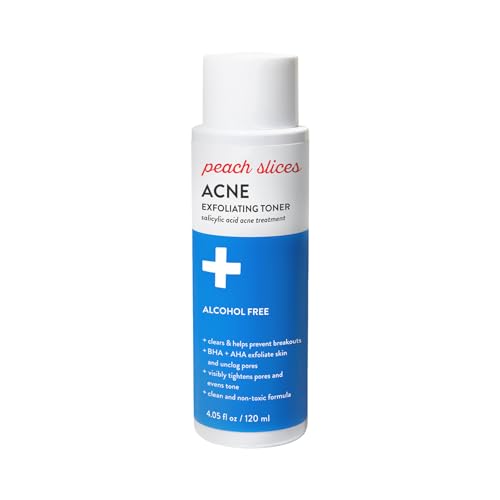
Best for: clogged pores and blackheads on the nose and chin Skip it if: your main concern is dullness rather than breakouts
If your skin problem is texture you can feel with a fingertip, this is your acid. Salicylic is oil-soluble, so it works inside the pore rather than across the surface. At 2% it's at the strength you'd normally see in an acne treatment, and it's the only BHA figure published anywhere in this set.
The bottle holds 4.05 fl oz, weighs 4 oz, and measures 1.61 x 5.39 x 1.61 in, making it the tallest and narrowest of the liquids. Peach Slices says lactic and glycolic acids sit alongside the salicylic, with cucumber, acerola and allantoin, and describes it as step two of a three-step acne system. That system framing is worth noting: the brand designed it to work with a matching cleanser and moisturiser, though nothing stops you using it alone.
Compared with The Ordinary, this trades tone-evening for pore-clearing. Compared with medicube, you get a stated percentage but you have to measure the dose yourself.
The trade-off is price position. It sits in the upper half of this set for a bottle that's only 0.65 fl oz larger than the winner, and salicylic on already-dry patches can be drying.
Pros:
- Publishes 2% salicylic, the only BHA figure here
- Lactic and glycolic listed alongside per the brand
- Slim 1.61 in width fits a narrow shelf
- Targets clogged pores rather than surface dullness
Cons:
- Second-most-expensive pick in this set
- Designed as one part of a three-step system
- No published weight advantage over cheaper bottles
- Salicylic can be drying on flaky areas
4. MAREE Exfoliating Toner with Salicylic Acid — Best minimal setup
The biggest bottle in this set at 6.76 fl oz, stacking four acids so one product covers the whole exfoliating job.
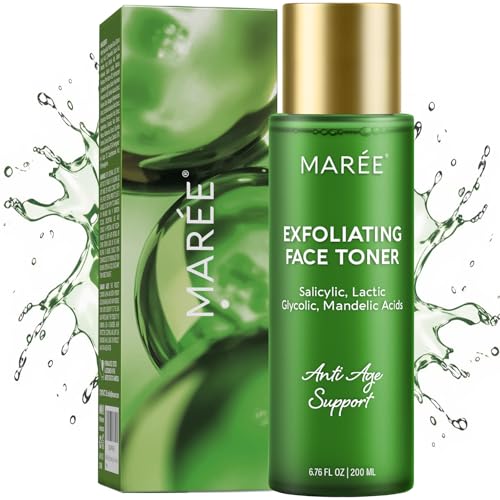
Best for: one product doing the whole exfoliating job, in the largest bottle here Skip it if: you want a published ingredient percentage before you apply anything
Volume is the headline. At 6.76 fl oz this holds double what the winner does and roughly two-thirds more than the two 4.05 fl oz bottles. If you're going to use one acid step for a year and nothing else, this is the bottle that lasts.
MAREE claims a four-acid complex: glycolic, lactic and mandelic on the AHA side, salicylic on the BHA side. The brand also says hyaluronic acid is included for hydration and that the texture absorbs quickly. Stacking both acid families in one product means you don't need to alternate two bottles across the week, which is genuinely useful for someone who won't remember which night is which.
Mandelic is the interesting inclusion. It's a larger AHA molecule than glycolic, and it's usually chosen for slower, gentler action. That combination reads as designed for a lower-irritation multi-acid, though without percentages I can only note the intent.
The trade-off is disclosure. Four acids and not one number, so you're trusting the formulation blind, and it sits mid-range in price with fewer published specifications than any other pick here.
Pros:
- Largest volume in this set at 6.76 fl oz
- Covers AHA and BHA in one step, per the brand
- Mid-range price for the most liquid here
- Hyaluronic acid listed for hydration
Cons:
- No percentage published for any of the four acids
- Fewest published specifications of the five: no weight, no dimensions
- Four acids at once raises irritation risk for reactive skin
- Newest formula here with the least history in the category
5. Avatara Kombucha The Clean Sweep Face Toner — Best budget pick
The cheapest of the five, and the only one whose listing is written for teen skin.

Best for: a cautious first step with witch hazel and bakuchiol alongside the glycolic Skip it if: you want a formula with a track record in this category
This is the cheapest pick here and the only one whose own listing describes itself as hydrating skincare for teens. Take that as marketing rather than proof, but it does tell you who Avatara wrote the formula for.
The bottle holds 4.05 fl oz and weighs 5.93 oz, heavier than either 4.05 fl oz rival, which suggests thicker glass. Avatara says glycolic acid and witch hazel sweep away excess oil, and that bakuchiol is included as a calming, pore-minimising element. Bakuchiol is the unusual one: it's usually positioned as a gentler alternative to retinol, so seeing it in a toner is a genuine point of difference within this group.
I'd start here if you're nervous about acids and want the lowest-commitment entry, then step up to a published percentage once you know how your skin reacts.
The honest problem is traction. This sells far slower than everything else in this set, which means fewer people have made it part of a routine, and the listing carries a 2026 release date. It's the least proven formula here by a wide margin.
Pros:
- Cheapest of the five picks
- Only listing in this set written for teen skin
- Bakuchiol and witch hazel included per the brand
- 4.05 fl oz for the lowest price position here
Cons:
- The slowest seller of the five by a large gap
- No acid percentage published at all
- Very new to the category, so little track record
- Heaviest 4.05 fl oz bottle at 5.93 oz
Pads or liquid: which format suits a teen routine?
Format is the second decision, after acid family, and it splits this set cleanly. Four of five picks are liquids you apply with a cotton round. One is a jar of pads.
Pads win on dose control. One pad, one application, no chance of soaking a round until it's dripping. For a teenager learning how much is enough, that guardrail is worth real money. medicube's 70-count jar is the only pick offering it.
Liquids win on cost per use and on volume. A 6.76 fl oz bottle from MAREE gives you months more than 70 pads, and you can adjust how much you use as your skin adapts. You just have to be honest about not overdoing it.
Where pads lose: they're bulky at 3.43 x 3.98 x 3.54 in, they generate waste, and the jar lid has to be closed properly or the pads dry out.
Where liquids lose: nothing stops you using too much. That's the whole risk.
If you share a bathroom and your routine has to survive a rushed morning, pads. If you want the longest-lasting product, the 6.76 fl oz bottle.
How long does one bottle last?
Exfoliating acids aren't daily products, especially not for skin under 20. Two to three nights a week is the sensible range, and that changes the maths on every size here.
At three uses a week, roughly 156 uses a year:
- 3.4 fl oz (The Ordinary): the smallest bottle, so expect to reorder soonest
- 4.05 fl oz (Peach Slices, Avatara): about 20% more liquid than the winner
- 6.76 fl oz (MAREE): double the winner's volume, the longest-lasting liquid here
- 70 pads (medicube): roughly five to six months at three uses a week, and you can count exactly what's left
That last point is underrated. A jar of pads tells you how much you have. A bottle doesn't, until it's suddenly empty.
Most shoppers miss that the biggest bottle isn't automatically the best value, because acids degrade over time once opened. If a 6.76 fl oz bottle takes you 14 months to finish, the last few applications are working less hard than the first.
What these listings do not tell you about teen skin
The best exfoliating toner for teens is partly a question these listings can't answer, so here's what to check for yourself.
Nothing here states an age recommendation. Only Avatara's listing mentions teens, and that's marketing language. Nobody publishes a minimum age.
Sunscreen is not optional with any of these. Glycolic and salicylic both leave skin more sun-sensitive. That's why The Ordinary's listing specifies evening use. None of these five includes SPF, and none of these listings sells you the sunscreen you'll need alongside it.
No pick publishes a warranty or satisfaction guarantee. That's normal for the aisle, but worth knowing before you commit.
Every one of these has only a couple of sellers listing it, so you're buying from a short list rather than a crowded field.
Layering is where things go wrong. Adding an acid toner on top of an existing benzoyl peroxide or retinol routine is how teenagers end up with peeling, stinging skin. One new active at a time, introduced twice a week, is the rule that prevents most of it.
The verdict
Split this by what you're willing to spend, because each tier buys something different.
At the entry end, The Ordinary Glycolic Acid 7% Exfoliating Toner is the best exfoliating toner for teens and the pick I'd default to. It publishes its acid and its percentage, which no other bottle in this tier does, and 3.4 fl oz is plenty for a twice-weekly habit. Avatara sits below it on price with witch hazel and bakuchiol, but it publishes no percentage and sells far slower than everything else here.
In the middle, MAREE buys you volume. At 6.76 fl oz it holds double the winner and covers AHA and BHA in one bottle, which suits a routine that won't tolerate two alternating products. You're trading published percentages for that convenience.
At the premium end, you're paying for measured doses. medicube's 70 pads take the guesswork out of application, and it's the pick buyers choose most often across this set. Peach Slices sits just below it and is the sharper choice if blackheads are the actual problem, since 2% salicylic is the only BHA figure published anywhere here.
The cutoff is simple: dullness and rough texture point to glycolic, clogged pores point to salicylic.
FAQ
Is an exfoliating toner worth it for a teenager?
An exfoliating toner is worth it for a teenager whose main complaints are rough texture, dullness or blackheads, and who is willing to use it two or three nights a week rather than daily. It's not worth it as an extra layer on top of an already busy acne routine, where it usually causes more irritation than improvement.
Which offers better value, The Ordinary or MAREE?
Better value between The Ordinary and MAREE depends on how you count it. MAREE holds 6.76 fl oz against The Ordinary's 3.4 fl oz, so it wins on volume for a mid-range price. The Ordinary is cheaper and publishes 7% glycolic, so it wins on knowing what you're applying. Volume or transparency, pick one.
What percentage of acid should a teen start with?
The percentage of acid a teen should start with is the lowest one you can actually verify. Only two picks here publish figures: 7% glycolic from The Ordinary and 2% salicylic from Peach Slices. Both are standard entry strengths. What matters more is frequency, so start at twice a week and stop there if your skin tightens or stings.
medicube pads or Peach Slices toner for breakouts?
For breakouts, medicube pads and Peach Slices toner take different routes. Peach Slices publishes 2% salicylic acid, which works inside oily pores and is the sharper choice for blackheads. medicube claims salicylic among three acids without a percentage, but delivers 70 pre-measured doses. Choose Peach Slices for a known dose, medicube for controlled application.
What is the biggest mistake with exfoliating toners?
The biggest mistake with exfoliating toners is using them every night. Acids strip faster than skin rebuilds, and daily use on teen skin often produces the shiny, tight, peeling look people mistake for progress. The second mistake is skipping sunscreen afterwards. The Ordinary's listing specifies evening use for exactly that reason.
Start with The Ordinary Glycolic Acid 7% Exfoliating Toner two nights a week, on clean skin, in the evening, and add nothing else new for a month. That single change is enough to tell you whether acids suit your skin at all, and it costs less than most of this aisle. If you find yourself over-pouring, switch to medicube's 70 pads and let the format do the measuring. The reason the winner takes it isn't strength or size. It's that you can read the number on the bottle and know exactly what you just put on your face.