Best Organic Beginner Retinol Cream by Strength

Seven retinol creams compared on published strength, jar size and packaging, with a named winner for first-time users and clear conditions that flip the pick to something gentler or larger.

By Jessica TurnerUpdated 19 min read
On this page
- Best organic beginner retinol cream at a glance
- How I cut a long list down to seven
- What does organic actually mean on a retinol label?
- Why percentage is the wrong first question
- 1. Kleem Organics Kleem Retinol Face Moisturizer — Best overall
- 2. LilyAna Naturals Anti Aging Retinol Face Cream for Women — Best for beginners
- 3. Dr.Althea Pure Retinol 0.15% Cream — Best lightweight
- 4. FRANKLY Retinol 0.1% Cream — Best budget pick
- 5. Advanced Clinicals Retinol Body Lotion & Face Moisturizer — Best for heavy use
- 6. Passport to Organics Retinol 2.5% High Potency Face Cream — Best premium
- 7. VOIBELLA BEAUTY Advanced Organic Retinol Pore Refining — Best for families
- How long does one jar last at two nights a week?
- Which pick wins if your skin reacts to everything?
- What the listings do not tell you
- The verdict
- FAQ
The best organic beginner retinol cream is the Kleem Organics Kleem Retinol Face Moisturizer, a 1.7 fl oz night cream in an airless pump that the brand pairs with hyaluronic acid and panthenol. If your skin flares at the first hint of retinol, the Dr.Althea Pure Retinol 0.15% Cream is the gentler route at 0.7 fl oz with 10,000ppm panthenol. The seven picks here split cleanly by price tier, and each tier buys something different: entry gets you a stated percentage or a large jar, the middle buys soothing extras, and the top buys either airless packaging or raw strength.
Best organic beginner retinol cream at a glance
| Pick | Stated retinol | Size | Price |
|---|---|---|---|
Best overall Kleem Organics Kleem Retinol Face Moisturizer |
Not published | 1.7 fl oz | Check Price |
Best for beginners LilyAna Naturals Anti Aging Retinol Face Cream for Women |
Not published | 1.7 oz | Check Price |
Best lightweight Dr.Althea Pure Retinol 0.15% Cream |
0.15% (1,500ppm claim) | 0.7 fl oz | Check Price |
Best budget pick FRANKLY Retinol 0.1% Cream |
0.1% claim | 1.01 oz | Check Price |
Best for heavy use Advanced Clinicals Retinol Body Lotion & Face Moisturizer |
Not published | 16 oz | Check Price |
| 2.5% claim | 1.7 oz | Check Price | |
Best for families VOIBELLA BEAUTY Advanced Organic Retinol Pore Refining |
Not published | 1.7 fl oz | Check Price |





How I cut a long list down to seven
Three things knocked candidates out before I looked at anything else.
The first was packaging that tells you nothing. Retinol degrades on contact with air and light, so a listing that shows an open-mouth jar and publishes no dimensions gives you no way to judge whether the formula survives a month on your bathroom shelf. Two of the seven here publish airless or narrow-neck packaging in the specifications, and that mattered.
The second was a size that makes the maths impossible. A cream sold in a size nobody publishes is a cream you cannot plan around. Every pick below has a published volume, from 0.7 fl oz to 16 oz, which is a 22x spread across one shortlist.
The third was a mismatch between the listing's own promise and its own claims. A cream that sells itself on gentleness while claiming one of the highest over-the-counter strengths available is not a beginner cream, whatever the headline says.
What survived is a set that covers the whole range of first-retinol decisions:
- Two entry-tier creams with a stated percentage on the label
- One mid-tier soothing formula built around panthenol and Centella
- Three creams at 1.7 oz, the standard face-cream size
- One 16 oz bottle intended for body use as well as face
What does organic actually mean on a retinol label?
Here's the honest answer, and it is the most important paragraph in this guide. "Organic" is not a regulated skincare term in the way it is on food, and Amazon's search does not filter for it. Two of these picks carry it in the brand name, Kleem Organics and Passport to Organics, and one carries it in the product name, VOIBELLA's Advanced Organic Retinol. That is branding, and I cannot verify a certification from a listing.
So treat organic as your own check, not mine. Nothing in the supplied data lets me confirm which of these seven meets any organic standard, and I'm not going to pretend otherwise.
What the listings do publish, and what you can actually use:
- FRANKLY states its formula is vegan and free from parabens, GMOs and artificial dyes, and unscented
- Dr.Althea states vegan certification and no artificial colouring, fragrance or parabens
- Passport to Organics states fragrance free, no sulfates, no parabens
- LilyAna Naturals states a clean, vegan and cruelty-free commitment
- Kleem Organics states a cruelty-free formula made in the USA
Those are specific, checkable claims. If a certified-organic formula is non-negotiable for you, read the ingredient list on the live listing before you buy any best organic beginner retinol cream, including the winner here.
Why percentage is the wrong first question
Most retinol guides open with strength, and strength is the number buyers fixate on. It is not what decides a first purchase.
Retinol irritation is dose over time, not dose per application. A 0.1% cream used nightly on unprepared skin will peel you faster than a 0.15% cream used twice a week alongside panthenol and ceramides. The supporting formula and the frequency you can actually sustain do more work than the headline figure.
Which is why the number that matters more is the buffering package. Dr.Althea publishes 10,000ppm panthenol against 1,500ppm retinol, a roughly 6.7:1 ratio of soothing agent to active. Kleem pairs its retinol with hyaluronic acid and panthenol. FRANKLY names ceramides and ginseng extract. Those are the ingredients that decide whether night four is comfortable.
The second number that matters is size, because size sets your runway. Three creams here are 1.7 oz. One is 1.01 oz. One is 0.7 fl oz. At two or three nights a week, that spread is the difference between one season and most of a year.
Kleem's own listing tells you to begin at two to three nights per week and increase as tolerated. That instruction is the real spec. Any of these creams used every night from day one will go badly, whatever percentage sits on the front.
1. Kleem Organics Kleem Retinol Face Moisturizer — Best overall
A full-size 1.7 fl oz night cream in airless pump packaging, with published guidance to start at two or three nights a week.
Best for: first-timers who want a full-size night cream in airless packaging Skip it if: you want a published retinol percentage on the label
What sets this apart in this set is the packaging plus the instruction. Kleem says the cream ships in an airless pump designed to help maintain freshness, and it is the only pick here whose listing pairs that with an explicit ramp-up schedule of two to three nights weekly. For someone who has never used retinol, that schedule is worth more than a percentage figure.
The size is the standard 1.7 fl oz, matching LilyAna, Passport to Organics and VOIBELLA, but the shipped weight of 6.67 oz and 2.4 x 2.4 x 2.83 in footprint tell you this is a squat bottle with real glass or heavy plastic, not a slim tube. Kleem describes hyaluronic acid and panthenol for hydration and says the texture absorbs quickly without a heavy feel. It also says the formula suits dry, oily and sensitive skin, and recommends daytime SPF.
The trade-off is transparency. This is the second-most-expensive pick here, and unlike FRANKLY, Dr.Althea and Passport to Organics, it publishes no retinol concentration. You are buying the packaging and the routine advice, not a number you can compare.
Pros:
- Airless pump packaging claim, unusual in this set
- Full 1.7 fl oz size at the standard face-cream volume
- Listing specifies a two-to-three-nights-weekly starting schedule
- Hyaluronic acid and panthenol named as supporting hydrators
- Stated as suitable for dry, oily and sensitive skin
Cons:
- No published retinol percentage
- Second-highest price position here
- Sells more slowly than four of the other six
- Only two sellers list it
2. LilyAna Naturals Anti Aging Retinol Face Cream for Women — Best for beginners
The one buyers choose most often among the face-focused picks here, in a 1.7 oz tube built for face and neck together.

Best for: cautious starters who want to treat the neck at the same time Skip it if: you dislike squeezing product from a tube
This is the second-cheapest cream in the set and the one that moves fastest among the face creams here, which tells you something about how many people start their retinol habit with it. It sits in the neck and décolleté category rather than face moisturizers, and the listing leans into that: LilyAna describes a cream formulated for face and neck, gentle enough for sensitive skin while firming the neck area.
The specifications are the most complete of any pick. You get a 2024 release date, model LORI-2.5, a 2.08 oz shipped weight and a 2 x 4.25 x 2 in tube. That 4.25 in height is the tube shape, and it means the product travels flatter than Kleem's squat bottle. LilyAna names hyaluronic acid and vitamin E as the supporting hydrators and describes nightly use.
The catch is the tube itself. A squeeze tube exposes less product to air than an open jar but more than an airless pump, and unlike Kleem there is no freshness-packaging claim here at all. No retinol percentage is published either, so the "gentle" positioning rests on the brand's word.
Pros:
- Second-cheapest of the seven
- Fastest-moving face cream in this set
- Formulated for face and neck in one step
- Most complete published specifications, including a 2024 release
- Hyaluronic acid and vitamin E named in the formula
Cons:
- No published retinol concentration
- No packaging claim about limiting air exposure
- Tube dispensing is less controlled than a pump
- The "gentle for sensitive skin" claim is the brand's own
3. Dr.Althea Pure Retinol 0.15% Cream — Best lightweight
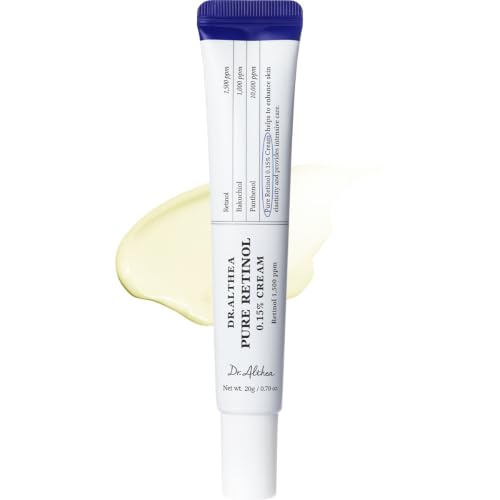
A 0.7 fl oz serum-textured cream with a published 10,000ppm panthenol level against 1,500ppm retinol.
Best for: reactive, dehydrated skin that flakes on stronger creams Skip it if: you want the lowest cost per ounce
This is the pick I'd hand someone whose skin objects to everything. It is the only cream here that publishes both its active concentration and its soothing concentration, and the ratio is the point: 10,000ppm panthenol to 1,500ppm retinol. Dr.Althea also names Centella Asiatica, madecassoside, allantoin and Houttuynia Cordata, a barrier-support stack you normally see on calming creams rather than actives.
At 0.7 fl oz and 20 g it is by far the smallest container in the set, less than half the volume of the three 1.7 oz creams. The 1.97 x 2.36 x 2.36 in footprint makes it the most travel-friendly. It sits in the serums category rather than moisturizers, which fits the described texture. Dr.Althea calls it suitable for everyday use and vegan-certified, free from artificial colouring, fragrance and parabens.
Two real drawbacks. The tiny size means you'll reorder sooner than with any other pick, and it sits mid-range on price despite giving you the least product, so the cost per ounce is unfavourable. Kojic acid appears in the formula for tone, which some people find sensitising on its own.
Pros:
- Publishes both retinol and panthenol concentrations
- Centella, madecassoside and allantoin named for calming
- Smallest footprint at 1.97 x 2.36 x 2.36 in
- Vegan-certified, no fragrance or parabens claimed
Cons:
- Only 0.7 fl oz, the least product in the set
- Mid-range price for the smallest container
- Contains kojic acid, which can sensitise some skin
- Serum texture may not satisfy dry skin alone
4. FRANKLY Retinol 0.1% Cream — Best budget pick
The cheapest pick here and the only one pairing a stated 0.1% strength with ceramides in a 1.01 oz tube.

Best for: shoppers who want a stated 0.1% strength at the lowest price here Skip it if: you need a jar that lasts many months
If the percentage on the label is what settles your nerves, this is the cheapest way to get one. FRANKLY publishes 0.1% pure retinol, the lowest stated concentration in the set, and calls the formula beginner-designed. The listing names adenosine alongside retinol, plus ceramides and ginseng extract for moisture.
The tube is slim: 5.12 x 1.28 x 0.98 in and 1.41 oz shipped, holding 1.01 oz of product. That shape slips into a wash bag more easily than any of the 1.7 oz bottles. FRANKLY states the cream is vegan, never tested on animals, unscented, and free from parabens, GMOs and artificial dyes, and describes it as Korean-formulated.
Two honest problems. The 1.01 oz volume is small for a face cream you use several times a week, so plan on reordering. And the listing copy is pushy in a way that undercuts confidence: one bullet ends with "Don't wait. ADD TO CART now," which is sales language sitting where an ingredient explanation should be. That does not make the formula bad, but it does mean you're reading marketing rather than a spec sheet.
Pros:
- Cheapest of the seven
- Publishes a 0.1% retinol concentration
- Ceramides and adenosine named in the formula
- Slim 5.12 in tube travels well
- Unscented, vegan and paraben-free per the listing
Cons:
- Only 1.01 oz of product
- Listing copy leans on hard-sell language over detail
- No packaging claim about limiting air exposure
- Only two sellers list it
5. Advanced Clinicals Retinol Body Lotion & Face Moisturizer — Best for heavy use
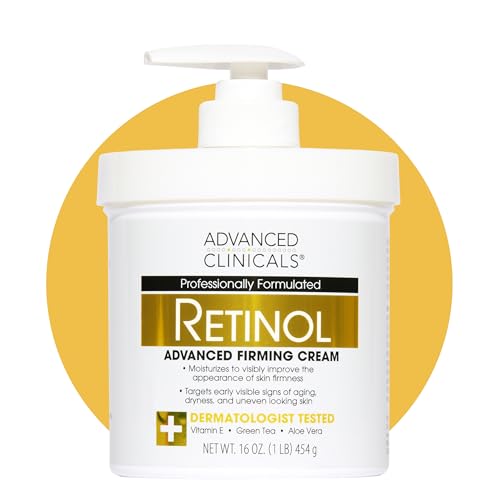
A 16 oz bottle, roughly nine times the volume of any face-only pick here, intended for body and face.
Best for: anyone treating arms, chest and legs alongside the face Skip it if: your face is the only thing you're treating
The 16 oz size changes what this product is for. Every other pick here is a face cream between 0.7 and 1.7 oz. This is a 1.05 lb bottle in a 5 x 3.5 x 3.5 in footprint, and Advanced Clinicals positions it for body and face together, targeting the look of crepey dry skin on arms, chest and legs as much as facial lines.
That makes it the fastest-selling product in the whole set, which makes sense: it is the only option that covers a whole body. The listing names vitamin E, green tea and aloe vera as supporting ingredients and describes a velvety texture that absorbs easily. Nightly use is the recommendation. Model designation is Retinol Body Lotion, and it is the third-cheapest pick here despite the volume, so the cost per ounce is not close to anything else.
The compromises are real. No retinol percentage is published. A body-scale lotion is formulated for tougher skin than the face, and a 16 oz bottle sitting open for months is the least air-protected option here. If you only want a facial night cream, you're buying a lot of lotion you won't use before it ages.
Pros:
- 16 oz, the largest volume in this set by a wide margin
- Covers body and face from one bottle
- Third-cheapest pick despite the size
- Vitamin E, green tea and aloe vera named as support
- Fastest-selling product across all seven picks
Cons:
- No published retinol percentage
- Body-scale formula, not a targeted facial treatment
- Large bottle means a long open-air lifespan
- 1.05 lb bottle is not travel-friendly
6. Passport to Organics Retinol 2.5% High Potency Face Cream — Best premium
A stated 2.5% formula in 1.7 oz, the strongest published concentration here and the wrong starting point for most beginners.

Best for: experienced users stepping up to a stated 2.5% formula Skip it if: this is your first retinol, full stop
I have to be blunt here, because the listing is not. Passport to Organics states 2.5% retinol and describes it as one of the highest over-the-counter strengths available. That is roughly 25 times the stated concentration of FRANKLY's 0.1% cream. Calling that a beginner product would be irresponsible, so I won't.
Where it earns a place is as the graduation step. If you've already run a 0.1% or 0.15% cream for several months without trouble, this is the one pick in the set that publishes a meaningfully higher figure. The formula includes vitamin C, hyaluronic acid and essential oils, with a 1.7 oz size, a 2024 release date and a one-pump-per-evening instruction for face and neck. Passport to Organics states fragrance-free, no sulfates or parabens, and cruelty-free.
The problems stack up. It is the most expensive pick here. Its specifications are the thinnest of the seven, with no published weight or dimensions. It sells the most slowly of all seven. And essential oils plus vitamin C alongside 2.5% retinol is a combination that can compound irritation rather than buffer it.
Pros:
- Highest published retinol concentration at 2.5%
- Vitamin C and hyaluronic acid named in the formula
- 1.7 oz full size with a 2024 release date
- Fragrance-free with no sulfates or parabens claimed
Cons:
- Too strong for a genuine first retinol
- Most expensive pick in the set
- Thinnest published specifications, no weight or dimensions
- Slowest-selling of the seven
- Essential oils may add irritation at this strength
7. VOIBELLA BEAUTY Advanced Organic Retinol Pore Refining — Best for families
A 1.7 fl oz pore-focused night cream in a tall 6.23 in bottle, sold on gentleness rather than a stated strength.

Best for: households sharing one pore-focused night cream Skip it if: you want a published strength or ingredient list detail
The angle here is pores rather than lines, which is genuinely different from the rest of the set. VOIBELLA describes a pore-refining retinol formula it calls gentle and non-drying, and it is the only pick whose listing leads on the appearance of pores. For a shared bathroom where two or three people have different concerns, a pore-and-texture cream at 1.7 fl oz covers more ground than a targeted wrinkle treatment.
The physical shape stands out too. At 6.23 x 1.43 x 1.43 in and 1.7 oz, this is the tallest and slimmest container in the set, a narrow bottle rather than a wide jar. A narrow neck means less surface area exposed each time you open it.
Now the weaknesses, and there are several. This is the third-most-expensive pick and it publishes no retinol percentage and almost no ingredient specifics beyond "natural and organic ingredients." Two of its four listing bullets are written as questions about tired skin and compliments from friends, which is copy rather than information. It is also the second-slowest seller here. You are buying a category positioning, not a formula you can compare against the picks that publish numbers.
Pros:
- Only pick positioned specifically around pore appearance
- Full 1.7 fl oz size at a standard face-cream volume
- Tall 6.23 in narrow bottle, smallest opening in the set
- Described as gentle and non-drying by the brand
Cons:
- No published retinol concentration
- Almost no specific ingredients named
- Third-highest price position with the least published detail
- Second-slowest seller of the seven
- Listing bullets read as marketing questions, not specifications
How long does one jar last at two nights a week?
This is the calculation almost nobody runs before buying, and it changes which cream is actually good value.
Work it in nights, not months. A pea-sized amount is the standard face dose, and at two to three nights a week you're looking at roughly 8 to 13 applications a month.
Ranked by how long the container lasts at that pace:
- Advanced Clinicals, 16 oz — the longest runway by a distance, though it's a body-scale bottle
- Kleem, LilyAna, Passport to Organics, VOIBELLA, all 1.7 oz — the standard face-cream size, the reference point for everything else
- FRANKLY, 1.01 oz — about 60% of the volume of a 1.7 oz jar
- Dr.Althea, 0.7 fl oz — roughly 41% of a 1.7 oz jar, the shortest runway here
The trap is buying the cheapest cream in the set and reordering three times before someone with a 1.7 oz jar reorders once. FRANKLY is genuinely the cheapest pick, but it holds less product than four of the six others. Dr.Althea sits mid-range on price with the least product of all.
Two counterpoints worth holding. A small jar finishes before the formula degrades, which matters for an air-sensitive active. And if retinol turns out not to suit you, a 0.7 fl oz tube is a much smaller thing to abandon than a 16 oz bottle.
Which pick wins if your skin reacts to everything?
Dr.Althea, and the reason sits in two published numbers rather than a marketing promise.
Its listing states 1,500ppm retinol against 10,000ppm panthenol. That is the only pick in this comparison that quantifies both the active and the barrier support, so it's the only one where you can see the buffering rather than take it on faith. The Centella Asiatica, madecassoside and allantoin stack reinforces that.
The frequency plan matters as much as the product. Whichever best organic beginner retinol cream you choose, start at two nights a week, moisturise on the off nights, and hold that pace for a full month before you increase anything. Kleem's own listing says the same, and it applies to every pick here.
Three conditions flip the recommendation away from Dr.Althea:
- If dryness is your main complaint rather than reactivity, Kleem's hyaluronic acid and panthenol pairing in a richer 1.7 fl oz cream serves you better than a serum texture.
- If you want the lowest stated strength on the label, FRANKLY's 0.1% is lower than Dr.Althea's 0.15%, and it costs less.
- If your neck bothers you as much as your face, LilyAna is the pick formulated for both, and it's the second-cheapest here.
What the listings do not tell you
Four blanks worth knowing about before you buy any of these.
None of the seven publishes a warranty. Not one. That is normal for skincare, but it means returns are down to the platform's policy rather than a brand guarantee.
Only two sellers list each of the seven picks. Every single one. That's a thin supply picture across the whole set, which is worth knowing if you plan to reorder the same cream repeatedly.
Retinol percentage is missing on four of the seven. Kleem, LilyAna, Advanced Clinicals and VOIBELLA publish no concentration at all. Three do: FRANKLY at 0.1%, Dr.Althea at 0.15%, Passport to Organics at 2.5%. That's the sharpest split in this comparison, and it's the one you can act on.
Packaging protection is mostly unstated. Kleem is the only pick claiming airless packaging. Everything else you infer from dimensions: VOIBELLA's 1.43 in width and LilyAna's tube shape suggest narrow openings, while a 16 oz bottle in a 3.5 in footprint does not.
Two things you can do about all this. Read the ingredient list on the live listing rather than the bullets, because the bullets are written to sell. And check the packaging photo for a pump versus an open jar, since air exposure does more to a retinol formula over six months than a 0.05% difference in strength.
The verdict
Three tiers, three different purchases, and the tier you pick should follow your experience level rather than your budget.
Entry tier. FRANKLY at 1.01 oz and LilyAna at 1.7 oz are the two cheapest picks, and both are legitimate starting points. FRANKLY gives you a published 0.1% figure, the lowest stated strength here. LilyAna gives you 70% more product, the most complete specifications in the set, and coverage for the neck. If you want a number on the label, take FRANKLY. If you want the larger jar and a face-and-neck formula, take LilyAna. Advanced Clinicals also sits in this tier at 16 oz, and it's the right buy only if you're treating your body too.
Middle tier. Dr.Althea stands alone here, and it's the one I'd choose for genuinely reactive skin. The published 1,500ppm retinol against 10,000ppm panthenol is the clearest evidence of buffering in this comparison, and it's the only pick that quantifies both sides.
Premium tier. Kleem Organics takes the overall win because its 1.7 fl oz airless pump and explicit two-to-three-nights schedule solve the two problems that derail first-time retinol users: a degraded formula and too much too soon. VOIBELLA sits alongside it as the pore-focused option. Passport to Organics is the most expensive here and, at a stated 2.5%, belongs in your second year rather than your first.
FAQ
Is the best organic beginner retinol cream worth buying over a plain moisturiser?
Worth buying over a plain moisturiser depends on what you want changed. A moisturiser hydrates; retinol is an active that supports cell turnover, which is why these listings talk about texture, tone and fine lines. If your only complaint is dryness, a hydrator is cheaper and simpler. If texture bothers you, an active earns its place.
Which cream offers better value, FRANKLY or Dr.Althea?
Better value between FRANKLY and Dr.Althea splits on what you're paying for. FRANKLY is the cheapest pick here and holds 1.01 oz, so its cost per ounce is the friendlier of the two. Dr.Althea sits mid-range with only 0.7 fl oz, but it publishes 10,000ppm panthenol alongside 1,500ppm retinol. Pay less with FRANKLY, or pay more for quantified buffering.
What retinol percentage should a first-time user start with?
A first-time user is generally best served by the lowest stated concentration available, which among these picks means FRANKLY's 0.1% or Dr.Althea's 0.15%. Passport to Organics states 2.5%, roughly 25 times FRANKLY's figure, and that is a step for someone already tolerating retinol. Frequency matters as much: start at two nights weekly regardless of strength.
Can I use a retinol body lotion on my face?
Using a retinol body lotion on your face is a formulation mismatch in most cases. Advanced Clinicals markets its 16 oz bottle for both face and body, so that specific product is positioned for it. Body-scale lotions are generally built for thicker skin on arms and legs. If your face is your only concern, a 1.7 oz face cream is the better fit.
What is the biggest mistake people make when starting retinol?
The biggest mistake is frequency, not strength. Applying a new retinol cream every night from day one produces peeling and stinging that sends most people back to the shelf permanently. Kleem's own listing recommends two to three nights per week, increasing as tolerated. Daytime SPF is the second half of that instruction, and it's not optional.
Pick your starting frequency before you pick your cream, then buy the container that matches it. Two nights a week on a 1.7 oz jar gives you months of runway to find out whether retinol suits your skin at all, which is the only question that matters in month one. Kleem Organics is the default here because the airless pump keeps the formula intact across that whole stretch and the listing tells you the pace to hold. Read the live ingredient list before you commit, especially if certified-organic sourcing is the reason you searched for this in the first place.