Best Natural Exfoliating Toner by Acid Strength

Six exfoliating toners compared on published acid concentration, bottle size and format. Where the winner fits, when an enzyme formula makes more sense, and why the word natural does less work here than the percentage on the label.

By Jessica TurnerUpdated 18 min read
On this page
- Best natural exfoliating toner at a glance
- How six picks survived the cut
- What does natural actually mean on a toner label?
- Acid strength, format and the numbers that decide it
- 1. The Ordinary Glycolic Acid 7% Exfoliating Toner — Best overall
- 2. Thayers Exfoliating 2% AHA Toner Pads — Best for beginners
- 3. MAREE Exfoliating Toner with Salicylic Acid — Best for heavy use
- 4. Farmacy 2% Salicylic Acid Toner for Face — Most versatile
- 5. Natural Outcome Glycolic Acid Toner 5% for Face — Best for families
- 6. EQQUALBERRY Swimming Pool Toner — Best premium
- How long does one bottle actually last?
- Which pick suits your skin type?
- What the listings do not tell you
- The verdict
- FAQ
The best natural exfoliating toner is The Ordinary Glycolic Acid 7% Exfoliating Toner, because 7% is the highest published acid concentration in this set and it arrives in a 3.4 fl oz bottle at the lowest price position of the six. If your skin reacts badly to glycolic acid, the EQQUALBERRY Swimming Pool Toner swaps acids for protease enzymes in a 10.14 fl oz bottle instead.
This one is not for everybody. If your skin is already peeling, tight or actively irritated, no toner on this list is your next purchase. A plain moisturiser is. Come back in two weeks.
Best natural exfoliating toner at a glance
| Pick | Active | Size | Price |
|---|---|---|---|
Best overall The Ordinary Glycolic Acid 7% Exfoliating Toner |
7% glycolic acid | 3.4 fl oz | Check Price |
Best for beginners Thayers Exfoliating 2% AHA Toner Pads |
2% AHA blend | 60 pads | Check Price |
Best for heavy use MAREE Exfoliating Toner with Salicylic Acid |
4-acid AHA/BHA claim | 6.76 fl oz | Check Price |
Most versatile Farmacy 2% Salicylic Acid Toner for Face |
2% salicylic acid | 1.7 fl oz | Check Price |
Best for families Natural Outcome Glycolic Acid Toner 5% for Face |
5% glycolic acid | 8 oz | Check Price |
Best premium EQQUALBERRY Swimming Pool Toner |
protease enzyme claim | 10.14 fl oz | Check Price |


How six picks survived the cut
Three things got listings cut before I ranked anything.
First, no published acid or enzyme detail. A toner that says "exfoliating" on the front and names nothing on the back is a guess, not a purchase. Every one of these six names its active mechanism.
Second, no stated volume or count. Without a size figure you cannot work out how long a bottle lasts, and that turns out to be the difference between a cheap toner and an expensive one.
Third, the format was a wipe-and-toss cloth rather than a toner. Those belong in a different guide.
What survived splits cleanly into three formats:
- Liquid glycolic: The Ordinary at 7%, Natural Outcome at 5%.
- Liquid salicylic: Farmacy at 2%, MAREE with a multi-acid blend.
- Everything else: Thayers as pre-soaked pads, EQQUALBERRY as an enzyme formula with no acid percentage.
That split matters more than brand. Two picks in this set contain no AHA or BHA percentage on the label at all, and one of them is deliberate.
What does natural actually mean on a toner label?
Here's the awkward part. Amazon's results for the best natural exfoliating toner are not filtered for anything a regulator would recognise as natural, and none of these six carries a certification I can point to. So I will not tell you which one is naturally derived, because the listings do not support that claim in a way you could check.
What the listings do state is which plant-based ingredients sit alongside the actives:
- The Ordinary names Tasmanian pepperberry, aloe and ginseng, and describes the pepperberry as a known anti-irritant.
- Thayers names witch hazel in an alcohol-free formula.
- Natural Outcome names aloe vera and quinoa extract.
- Farmacy names papaya enzymes, moringa seed extract and chlorella.
- EQQUALBERRY names protease enzymes described as naturally derived, plus hyaluronic acid.
- MAREE names hyaluronic acid alongside its acid blend.
Those are manufacturer descriptions, not lab results. Treat them as a starting point for reading the full ingredient list on the listing page, not as a verdict. If "natural" to you means no synthetic acids at all, only one pick here qualifies on its own description, and it is the EQQUALBERRY. Everyone else pairs botanical extracts with a lab-made acid, which is a legitimate approach and also not the same thing.
The practical read: pick on the active, then check the botanicals for irritants you already know you react to.
Acid strength, format and the numbers that decide it
Most guides to the best natural exfoliating toner compare ingredient lists. That is the wrong lever. Acid strength paired with how often you can use it is what decides your result, and the two published numbers that tell you most are the percentage and the bottle size.
Here's the trick. A 7% glycolic acid used twice a week does less total exfoliating work over a month than a 2% salicylic used every night. Concentration alone tells you the intensity of a single application, not the outcome. So read the two together.
Where the six land:
- 7% glycolic (The Ordinary): the strongest single-acid figure here, labelled for once-daily evening use.
- 5% glycolic (Natural Outcome): a step down, positioned for daily addition to an existing routine.
- 2% AHA blend (Thayers): glycolic and lactic in a pre-dosed pad.
- 2% salicylic (Farmacy): oil-soluble, so it works inside pores rather than on the surface.
- Multi-acid (MAREE): glycolic, lactic, mandelic and salicylic per the listing, with no individual percentages stated.
- Enzyme (EQQUALBERRY): no acid percentage, because the mechanism is protease enzymes instead.
The AHA-versus-BHA split matters as much as the number. AHAs like glycolic and lactic work on the skin surface, which suits dullness and uneven tone. BHAs like salicylic are oil-soluble and reach into pores, which suits congestion and shine. Choose the mechanism that matches your complaint, then choose the strength you can tolerate.
1. The Ordinary Glycolic Acid 7% Exfoliating Toner — Best overall
A 7% glycolic acid in a 3.4 fl oz bottle at the lowest price position here makes this the default starting point for most shoppers.
Best for: someone who wants the highest published acid strength here Skip it if: your skin flares at glycolic acid
What separates this from the rest of the set is that it pairs the strongest published concentration with the cheapest position of the six. Nothing else here manages both. The 5% glycolic option costs more per bottle and delivers less acid per application; the 2% formulas cost more still.
The bottle is 4.8 x 1.81 x 1.81 in and weighs 3.53 oz, so it sits upright in a cabinet without hogging a shelf. The Ordinary says the formula includes Tasmanian pepperberry as an anti-irritant, plus aloe and ginseng. Read that as intent rather than proof: a 7% AHA is still a 7% AHA, and the brand's own instructions specify once daily, in the evening, away from the eyes. That is a meaningful restriction, and it is on the listing rather than buried.
An unusual detail: the listing states the toner can also be applied to the scalp to hydrate and rebalance dry scalp skin. None of the other five claims that.
The trade-off is intensity. This is the strongest single acid in the set and the least forgiving if you overdo it. It also gives you no dosing guardrails at all, unlike the pre-soaked pads at number two.
Pros:
- Highest published acid concentration in this set at 7%
- Cheapest of the six picks
- Sells faster than four of the other five here
- Compact 4.8 x 1.81 x 1.81 in bottle
- Listing states scalp use as well as face
Cons:
- Labelled evening-only, so no morning flexibility
- Easy to overapply from an open bottle with no dosing cue
- Smallest liquid volume of the four bottled picks except Farmacy
- Only two sellers list it
2. Thayers Exfoliating 2% AHA Toner Pads — Best for beginners
Sixty pre-soaked pads at a 2% AHA blend take the guesswork out of dosing, which is exactly what a first-time acid user needs.

Best for: first-time acid users who want dosing decided for them Skip it if: you dislike single-use pads
The format is the argument here. Every other pick asks you to decide how much liquid goes on the cotton pad, and beginners routinely get that wrong in the direction of too much. A pad carries a fixed dose. That single design choice is why this is the entry point I'd recommend over the 7% bottle for anyone who has never used an acid.
Thayers describes a dual-sided pad: a smooth face that saturates skin and swipes away impurities, and an embossed face for physical texture. The formula is described as alcohol-free, blending witch hazel with glycolic and lactic acid, and the brand states clinical testing showing smoother texture in one week and more even tone in two. Those are the manufacturer's claims, and the timelines are theirs, not mine. Released in 2025, it is the newest listing in this group.
At 60 count it is the second-cheapest here, and it is a swipe-and-go product with no bottle to knock over.
The cost is waste and control. You throw away 60 pads, you cannot adjust the dose downward on a sensitive night, and the embossed side adds physical scrubbing on top of chemical exfoliation.
Pros:
- Pre-dosed pads remove the overapplication risk
- 60 count, second-cheapest pick here
- Dual-sided design with smooth and embossed faces
- Alcohol-free formula per the listing
- Newest release in this set, 2025
Cons:
- 60 single-use pads means 60 pieces of waste
- No way to reduce the dose on a reactive day
- Embossed side adds friction some skin will not want
- 2% AHA is the weakest acid figure among the AHA picks
3. MAREE Exfoliating Toner with Salicylic Acid — Best for heavy use
At 6.76 fl oz with a stated four-acid blend, this is the pick for anyone treating more than just their face.
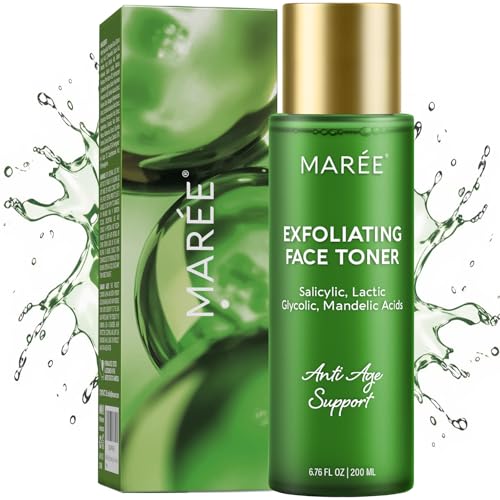
Best for: anyone treating face, neck and chest from one bottle Skip it if: you need published weight and dimensions before buying
Volume is the case. At 6.76 fl oz this holds twice the liquid of The Ordinary's 3.4 fl oz bottle and roughly four times the Farmacy's 1.7 fl oz, while sitting in the middle of the price range for this set. If you are sweeping a toner across your chest and the back of your neck as well as your face, that difference in size decides whether you run dry in six weeks or six months.
MAREE describes a four-acid complex of glycolic, lactic and mandelic AHAs alongside salicylic BHA, plus hyaluronic acid for hydration. No individual percentages are published, which is the honest limitation: you know what is in it but not how much. The brand describes the texture as Korean-inspired and quick to absorb.
The listing is also the thinnest here on specifications. There's no published weight, no dimensions and no model number, only the size and count. It is also the slowest-moving pick of the six that publish a strong sales position, and only two sellers stock it.
Against the others, you trade documented acid strength for documented volume. That is a real trade, not a free win.
Pros:
- 6.76 fl oz, second-largest bottle here
- Stated blend covers both AHA and BHA in one step
- Mid-range price position for a large bottle
- Hyaluronic acid included per the listing
Cons:
- No individual acid percentages published
- No weight, dimensions or model number listed
- Sells more slowly than the top three here
- Only two sellers list it
4. Farmacy 2% Salicylic Acid Toner for Face — Most versatile
A 2% salicylic acid plus papaya enzymes in one 1.7 fl oz bottle covers pore congestion and surface dullness together.

Best for: oily and combination skin with visible congestion Skip it if: you want the most product for the money
This is the only pick that publishes both a BHA percentage and an enzyme mechanism. Farmacy states 2% salicylic acid working inside pores, plus papaya enzymes for surface exfoliation, plus moringa seed extract and chlorella for antioxidant support. That combination is why it earns the versatile label: you are covering two exfoliation routes with one product instead of layering two.
Salicylic acid is oil-soluble, which is the technical reason it suits oily and blemish-prone skin better than a glycolic does. Farmacy positions it squarely at combination, oily and blemish-prone complexions and says it exfoliates without over-stripping. The brand's framing, not a measurement.
Now the maths. At 1.7 fl oz this is the smallest volume in the set, and it sits in the premium price tier. Per swipe it is easily the most expensive way to exfoliate here. The published dimensions of 50.4 x 15.7 x 15.7 in are clearly a listing error rather than a real box, so ignore them and treat 1.7 fl oz as the figure that matters.
Compared with the 7% glycolic winner, you get a gentler mechanism, a smaller bottle and a higher price. Worth it only if congestion, not tone, is your actual problem.
Pros:
- Only pick pairing a stated BHA percentage with enzymes
- Oil-soluble 2% salicylic suits oily and congested skin
- Antioxidant extracts named on the listing
- Smallest bottle is easy to travel with
Cons:
- 1.7 fl oz is the smallest volume of all six
- Premium price position for the least product
- Published dimensions are obviously wrong on the listing
- No weight-per-use guidance to plan refills
5. Natural Outcome Glycolic Acid Toner 5% for Face — Best for families
Eight ounces of 5% glycolic acid gives two people a shared bottle that lasts, at a gentler strength than the winner.

Best for: two people sharing one gentle glycolic bottle Skip it if: you want the strongest acid in this set
Two numbers make the case: 8 oz and 5%. This is the largest glycolic bottle here and the second-strongest AHA figure, which is a genuinely useful combination if more than one person in the house is using it. The 2 percentage points it gives up against The Ordinary buy you a formula the brand positions for daily routine use rather than evening-only application.
Natural Outcome names aloe vera and quinoa extract alongside the acid, and describes the aloe as balancing the 5% concentration. The listing also claims pore tightening and moisture barrier support. Both are marketing framing. The measurable facts are the percentage, the 8 oz volume and the 2.5 x 6 x 2.55 in bottle, which is the second-largest footprint in this group and will not fit a cramped travel bag.
Where it struggles is attention. This is by far the slowest-moving listing of the six, and it sits in the mid price tier despite offering less acid than the cheapest pick here. You are paying more for volume and a gentler strength, not for a better active.
If one person is using it, the 7% winner is the better deal. If two are, the volume flips it.
Pros:
- Largest glycolic volume here at 8 oz
- 5% is the second-strongest AHA figure in the set
- Aloe vera and quinoa extract named on the listing
- Positioned for daily rather than evening-only use
Cons:
- Slowest seller of all six by a wide margin
- Costs more than the stronger 7% pick
- 2.5 x 6 x 2.55 in bottle is bulky for travel
- Pore-tightening claims are unquantified
6. EQQUALBERRY Swimming Pool Toner — Best premium
Ten fluid ounces of enzyme-based exfoliation, and the only pick here that contains no AHA or BHA by design.

Best for: reactive skin that cannot tolerate AHAs or BHAs Skip it if: you want a measurable acid percentage on the label
If glycolic and salicylic both sting, this is the one worth reading about. EQQUALBERRY states that instead of AHA and BHA it uses naturally derived protease enzymes to exfoliate, and pairs them with hyaluronic acid for hydration. Protease enzymes break down protein bonds between dead surface cells, which is a slower and typically milder route than an acid.
At 10.14 fl oz it is the largest bottle in the set, weighing 0.79 lb with a 2.44 x 5.98 x 2.48 in footprint. That is a lot of product, and it needs to be, because enzyme exfoliation generally works gradually. The brand describes the texture as thicker than water, absorbing without stickiness, and positions it for daily use on sensitive skin.
The catch is measurement. There is no enzyme concentration published, no strength figure, nothing you can compare against the 7% or the 2% on the other bottles. You are buying a mechanism, not a dose. It is also the most expensive pick here and the second-slowest seller.
Against the winner, you swap a documented number for a gentler approach and pay more for the privilege. For genuinely reactive skin that is a fair swap. For anyone else it is not.
Pros:
- Largest volume of the six at 10.14 fl oz
- Only acid-free mechanism in this set
- Hyaluronic acid included for hydration
- Positioned for daily use on sensitive skin
Cons:
- Most expensive pick here
- No enzyme concentration published anywhere
- Enzyme exfoliation typically works more slowly than acids
- Second-slowest seller of the six
How long does one bottle actually last?
Volume is the specification shoppers skip, and it is the one that changes the real cost of a best natural exfoliating toner over a year. Look at the spread in this set:
- 1.7 fl oz — Farmacy
- 3.4 fl oz — The Ordinary
- 6.76 fl oz — MAREE
- 8 oz — Natural Outcome
- 10.14 fl oz — EQQUALBERRY
- 60 pads — Thayers
The largest liquid bottle holds nearly six times what the smallest does. And the smallest sits in the premium price tier while the second-smallest sits in the entry tier. That is the whole argument for reading the size line before the ingredient line.
Two practical notes. A toner used on face only goes further than the same bottle used on face, neck and chest, so if you are treating a wider area, the 6.76 fl oz and larger options change the arithmetic. And a pad count is not directly comparable to a fluid ounce figure, because 60 pads is 60 applications while a bottle depends entirely on how heavy-handed you are.
Frequency matters too. An evening-only product like the 7% glycolic gets used at most 30 times a month. A daily-positioned formula could get used twice that. Multiply your realistic frequency by your area, then look at the volume column again.
Which pick suits your skin type?
Skip the brand names for a second. Start with the complaint.
- Dull, uneven tone, no oiliness. Glycolic. Start at 5% with Natural Outcome, move to 7% with The Ordinary if you tolerate it.
- Oily, shiny, congested pores. Salicylic. Farmacy at 2%, or MAREE if you want AHA coverage in the same bottle.
- Never used an acid before. Pre-dosed pads. Thayers, and use one every other night at first.
- Reactive, stinging, prone to redness. Enzymes rather than acids. EQQUALBERRY.
- Treating body skin as well as face. Volume first. MAREE at 6.76 fl oz or EQQUALBERRY at 10.14 fl oz.
Three conditions flip my top recommendation outright. If glycolic acid has ever left your face burning, the 7% is not a starting point at any price, and the enzyme option is. If you have never used a chemical exfoliant, the pad format's fixed dose is worth more than 5 extra percentage points of acid. And if two people are sharing, 8 oz at 5% beats 3.4 fl oz at 7% on simple arithmetic.
One more filter: if you also use retinol, do not stack a 7% AHA on the same nights. Alternate.
What the listings do not tell you
Four gaps run through this whole category, and knowing them protects you.
pH is never published. An AHA's real strength depends on pH as much as percentage. A 7% glycolic at a high pH does less than a 5% at a low one. None of these six states a pH, so treat every percentage as an upper bound rather than a guarantee.
Enzyme strength has no standard unit. The EQQUALBERRY names protease enzymes but no concentration, and there is no industry figure that would let you compare it against a percentage anyway.
"Clinically tested" and "dermatologist-tested" describe process, not outcome. Thayers uses both phrases. They mean a study or a safety check happened, not that a specific result is guaranteed for your skin.
Specification completeness varies wildly. The Ordinary publishes size, colour, count, weight, dimensions and model. MAREE publishes size and count. Farmacy publishes dimensions that are physically impossible. That inconsistency is not a quality signal, but it does tell you how much you can verify before you buy.
Practical response: buy the smallest viable size of any new active, patch test on your jaw for three nights, and only then commit to a 10 fl oz bottle.
The verdict
Entry tier is where this category is strongest, and it is not close. The Ordinary Glycolic Acid 7% Exfoliating Toner delivers the highest published acid concentration of the six from the cheapest position, in a 3.4 fl oz bottle with a full set of published specifications. If you have used an AHA before and your complaint is dull, uneven tone, buy it and stop reading. Thayers Exfoliating 2% AHA Toner Pads sits in the same tier and wins for anyone new to acids, purely because 60 pre-dosed pads make overapplication almost impossible.
The middle tier buys you volume rather than strength. MAREE gives you 6.76 fl oz and a four-acid claim; Natural Outcome gives you 8 oz at 5%. Both make sense if you are treating a large area or sharing the bottle, and neither beats the winner on documented acid strength.
The premium tier buys you a different mechanism, not a better one. Farmacy's exact advantage over the winner is oil solubility: 2% salicylic reaches into pores, which glycolic cannot, so congestion and shine are its territory. EQQUALBERRY's advantage is that it contains no acid at all, which matters enormously if acids irritate you and not at all if they don't.
The cutoff is your tolerance. Tolerate acids, shop entry tier. Don't, pay premium.
FAQ
Is a natural exfoliating toner worth it over a scrub?
A natural exfoliating toner is worth it over a scrub if your skin reacts badly to friction. Chemical actives like the 7% glycolic here or Farmacy's 2% salicylic dissolve the bonds between dead cells rather than abrading them off, so there's no grit and no scratching. Scrubs still have a place on rough body skin. On faces, the liquid route is usually gentler.
Which is better value, The Ordinary or Farmacy?
Better value between The Ordinary and Farmacy comes down to volume and mechanism. The Ordinary gives you 3.4 fl oz at 7% glycolic from the cheapest price position in this set. Farmacy gives you 1.7 fl oz of 2% salicylic from a premium position. On product per dollar The Ordinary wins clearly. Farmacy only justifies its cost if pore congestion, not surface dullness, is your problem.
How often should I use an exfoliating toner?
How often you should use an exfoliating toner depends on the strength and the label. The Ordinary states once daily, preferably in the evening. Natural Outcome at 5% is positioned for daily routine use, and EQQUALBERRY's enzyme formula is described as suitable for daily use on sensitive skin. Start at two or three nights a week regardless of the label, then increase only if nothing stings or flakes.
Can I use an exfoliating toner on sensitive skin?
You can use an exfoliating toner on sensitive skin, but the mechanism matters more than the brand. EQQUALBERRY skips AHAs and BHAs entirely in favour of protease enzymes, which is the safest starting point in this set for reactive skin. If you want an acid, start at 2% rather than 7%, use it twice a week, and patch test on your jawline for three nights first.
What is the difference between AHA and BHA toners?
The difference between AHA and BHA toners is solubility. AHAs like the glycolic in The Ordinary and Natural Outcome are water-soluble and work on the skin surface, which suits dullness and uneven tone. BHAs like the 2% salicylic in Farmacy are oil-soluble, so they penetrate into pores and suit oily, congested or blemish-prone skin. MAREE's listing claims both types in one bottle.
Start with the complaint on your face, not the label on the bottle. Uneven tone points you at glycolic, and The Ordinary's 7% in a 3.4 fl oz bottle is the cheapest route to the strongest published dose in this group, which is a rare combination in skincare and the reason it's the default here. Congestion points you at salicylic instead. Sensitivity points you at enzymes. Whichever you choose, buy one product, use it three nights a week for a month, and change nothing else in your routine. That way you'll know what actually worked.