Best Korean Toner for Mature Skin Over 40

Six Korean toners compared on the specs that matter for drier, less resilient skin: barrier ingredients, bottle size, texture and how much you actually get per bottle.

By Jessica TurnerUpdated 17 min read
On this page
- Best korean toner for mature skin at a glance
- Why three picks got cut before the shortlist
- Which ingredient actually decides a mature-skin toner?
- 1. TIRTIR Milk Skin Rice Toner — Best overall
- 2. Sulwhasoo Concentrated Ginseng Rejuvenating Water — Best premium
- 3. Anua Rice 70 Glow Milky Toner — Best for heavy use
- 4. medicube PDRN Toner Salmon DNA PDRN CICA Soothing Toner — Best for families
- 5. numbuzin No.9 NAD+ Salmon PDRN Toner — Best budget pick
- 6. Beauty of Joseon Ginseng Essence Water Hydrating Face — Most versatile
- Milky or watery: which texture suits drier skin?
- How long does one bottle really last?
- What the listings won't tell you about mature skin
- When a different pick wins
- The verdict
- FAQ
The best Korean toner for mature skin is the TIRTIR Milk Skin Rice Toner, a 5.07 fl oz milky formula built on ceramide, panthenol and niacinamide, the three ingredients that matter most once skin stops holding water on its own. If you want firmness claims backed by a published four-week study, Sulwhasoo Concentrated Ginseng Rejuvenating Water is the better buy at the same 5.07 fl oz size. What splits this field is not the hero ingredient on the front label. It's whether the formula includes barrier lipids at all.
Best korean toner for mature skin at a glance
| Pick | Key ingredients | Size | Price |
|---|---|---|---|
Best overall TIRTIR Milk Skin Rice Toner |
Ceramide, panthenol, niacinamide, rice bran | 5.07 fl oz | Check Price |
| Ginseng actives, 6-peptide blend | 5.07 fl oz | Check Price | |
Best for heavy use Anua Rice 70 Glow Milky Toner |
70% rice water claim, ceramides, niacinamide | 8.45 fl oz | Check Price |
Best for families medicube PDRN Salmon DNA CICA Toner |
Salmon PDRN, 5 peptides, cica, niacinamide | 8.45 fl oz | Check Price |
Best budget pick numbuzin No.9 NAD+ Salmon PDRN Toner |
NAD+, salmon PDRN, peptides, niacinamide | 5.07 fl oz | Check Price |
Most versatile Beauty of Joseon Ginseng Essence Water |
80% ginseng water claim, 2% niacinamide, BHA | 5.07 fl oz | Check Price |


Why three picks got cut before the shortlist
I started from the Face > Toners & Astringents listings and cut on three grounds before ranking anything.
The first cut was alcohol-forward astringents. A clarifying toner that strips oil is the wrong tool for skin that has already lost some of its own. Anything that led on "pore tightening" or "oil control" as its main function came out, which is most of the traditional astringent shelf.
The second cut was thin ingredient disclosure. Several listings named a single hero extract and stopped there. When a bottle costs real money, I want the listing to say whether there's niacinamide, panthenol or a ceramide in it. All six survivors name at least three actives.
The third cut was single-purpose exfoliating toners. Acid pads and glycolic tonics have a place, but they aren't a daily hydrating step, and treating them as one is how people end up with a stinging, shiny face by week three.
What survived: six toners across two sizes, all leaning on hydration and barrier language rather than tightening. One thing to know upfront. Amazon's results for this search don't filter by age, so only one listing here actually names mature skin in its title. Everything else is a judgment call based on the ingredient list, and I'll be clear about which is which throughout.
Which ingredient actually decides a mature-skin toner?
Most guides to the best korean toner for mature skin compare hero ingredients. Ginseng versus rice water versus PDRN. That comparison is entertaining and it decides almost nothing, because the hero ingredient is chosen by the marketing team and every one of these six also contains niacinamide.
Here's what actually matters. Skin that has thinned loses water faster than it replaces it, so the question is whether a toner leaves anything behind that slows the loss. That means lipids and humectant support, not extract percentages.
Rank these three things in order:
- Barrier lipids. Ceramides, in plain terms, are the fats that hold skin cells together. TIRTIR and Anua both name ceramides. The other four don't.
- Soothing humectants. Panthenol, glycerin, allantoin. These hold water at the surface and calm irritation. TIRTIR and Anua name panthenol; Anua adds glycerin and allantoin.
- Niacinamide. All six have it. Beauty of Joseon is the only one that publishes a percentage: 2%.
Peptides and PDRN sit below those three. They're interesting, and Sulwhasoo publishes an actual four-week elasticity result behind its 6-peptide blend, which is more than the others offer. But a peptide toner sitting on a compromised barrier is a wasted step. Fix the leak first.
1. TIRTIR Milk Skin Rice Toner — Best overall
A milky 5.07 fl oz toner that pairs ceramide and panthenol with niacinamide, which is the exact combination drier, less resilient skin needs from this step.
Best for: dry, reactive skin that needs barrier support twice a day Skip it if: you dislike milky textures under makeup
Within this set of six, only two toners name a ceramide, and TIRTIR is the cheaper of those two. That's the whole case, and it's a strong one. TIRTIR says the formula uses panthenol and ceramide to defend against external stressors and soothe dry or sensitive skin, plus niacinamide to even tone and improve moisture retention.
The texture is the other reason it wins. TIRTIR describes it as soft and milky rather than watery, and a slightly richer toner does more work on skin that drinks up a watery layer in seconds. Rice bran extract and chamomile flower round it out as the calming end of the formula.
It's the fastest-selling toner of the six here, which tells you the finish agrees with a lot of people. The bottle is a tall, narrow 7.4 x 1.97 x 1.97 in, so it fits a crowded shelf better than the wider 8.45 fl oz bottles.
The trade-off against Anua: you get the same ceramide-plus-niacinamide idea in a 5.07 fl oz bottle instead of 8.45 fl oz, so you'll repurchase sooner. Against Sulwhasoo, you lose the published firmness study.
Pros:
- Names both ceramide and panthenol, rare in this set
- Alcohol-free, per TIRTIR
- Milky texture suits skin that absorbs watery toners instantly
- Fastest-selling pick of the six
- Narrow 1.97 in footprint
Cons:
- Smallest volume tier at 5.07 fl oz
- Milky finish can pill under some sunscreens
- No fragrance-free claim on the listing
- No published clinical result, unlike Sulwhasoo
2. Sulwhasoo Concentrated Ginseng Rejuvenating Water — Best premium
The only pick here that names mature skin in its own title and backs its firmness language with a published four-week instrumental result.

Best for: someone building a routine around firmness and elasticity claims Skip it if: you go through toner quickly
Sulwhasoo is the most expensive pick here, and it's the one whose listing speaks directly to the reader searching for a toner for dry, normal and mature skin. That matters when everything else in this category is written for a general audience.
The evidence behind it is unusually specific for a toner. Sulwhasoo says elasticity visibly improved after four weeks of daily use, citing an instrumental result on 32 women. That's a small study and it's the brand's own, so treat it as a claim rather than proof. It's still more than the other five publish.
The formula centres on patented Korean ginseng actives plus a 6-peptide blend that the brand says supports the look of firmness. The suggested routine is a few drops pressed into skin morning and night, after a serum, which is a lighter application than the milky toners ask for.
At 5.07 oz and a compact 5.83 x 2.2 x 2.2 in, this is the shortest bottle of the six. It also sells far slower here than any other pick, which is what a premium price does to volume rather than a comment on the formula.
Pros:
- Only listing that names mature skin directly
- Published four-week elasticity result, brand-run
- Patented ginseng actives plus 6-peptide blend
- Shortest bottle at 5.83 in tall
Cons:
- Highest price position in this set
- No ceramide or panthenol named
- Only 5.07 fl oz, and a drops-based application still empties it
- Cited study covers just 32 women
3. Anua Rice 70 Glow Milky Toner — Best for heavy use
The larger 8.45 fl oz ceramide option, built for anyone who layers toner in three or four passes rather than one.
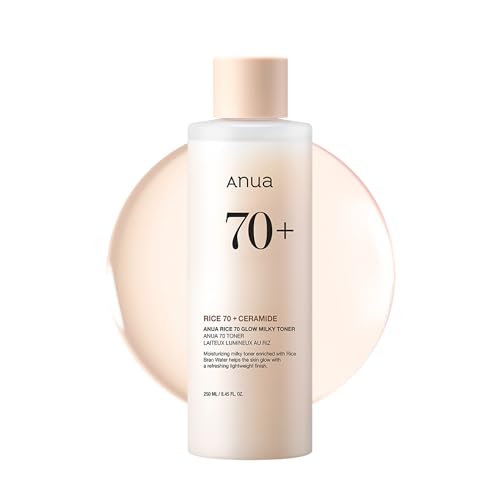
Best for: anyone who layers toner three or four times per application Skip it if: you want the smallest possible footprint on a shelf
If the TIRTIR formula appeals but 5.07 fl oz feels tight, this is the answer. Anua gives you 8.45 fl oz, which is 3.38 fl oz more product in a bottle that's actually shorter at 6.3 in tall, just wider at 2.36 in.
The ingredient story overlaps closely with the winner. Anua says the toner blends rice water, niacinamide and ceramides, with a proprietary rice cera-protein complex supporting the moisture barrier. It's also the only pick that names glycerin and allantoin alongside panthenol, giving it the deepest humectant list of the six. The listing puts rice water at 70%.
Two extra points in its favour: Anua states the formula is fragrance free, which none of the other five confirm, and non-comedogenic. It launched in 2024, making it the newest formula here.
The catch is positioning. Anua is one of the two premium-priced picks, so the larger bottle doesn't automatically mean better value per use. It also markets sebum balancing, which is a signal the formula leans lighter than a dry-skin buyer might want from a milky toner.
Pros:
- Largest volume tier at 8.45 fl oz
- Fragrance free, per the listing
- Names ceramides, panthenol, glycerin and allantoin
- Newest formula here, released 2024
- Non-comedogenic claim
Cons:
- Premium price position despite being a rice toner
- Widest bottle at 2.36 in across
- Sebum-balancing focus may run light for very dry skin
- No published clinical result
4. medicube PDRN Toner Salmon DNA PDRN CICA Soothing Toner — Best for families
An 8.45 fl oz watery toner with cica and five peptides, priced in the middle, which makes it the sensible pick when more than one person is using the bottle.

Best for: a shared bathroom where two or three people use the same bottle Skip it if: you avoid marine-derived ingredients
Two things make this the shared-bathroom choice. It's tied for the largest bottle at 8.45 fl oz, and it sits mid-range on price rather than premium, unlike the other 8.45 fl oz option here. That combination is what you want when a toner disappears twice as fast as expected.
The formula is broad enough to suit different skin at once. medicube names salmon DNA PDRN, five peptide complexes, niacinamide, cica and sodium hyaluronate, and says it addresses uneven tone and elasticity while reinforcing the barrier against moisture loss. Cica is the calming component, which is useful if one person in the house reacts to actives.
The texture is watery, listed as "salmon PDRN watery", so it presses in fast and layers well. medicube calls it non-sticky and easy to slot into any routine.
Against TIRTIR, the gap is barrier lipids: no ceramide is named here, so it's doing less to seal moisture in. Against Anua, it loses the fragrance-free confirmation. The bottle is also the tallest of the wide-bodied pair at 7.17 x 2.17 x 2.17 in.
Pros:
- 8.45 fl oz at a mid price position
- Five peptides plus cica for calming
- Names sodium hyaluronate and niacinamide
- Watery, non-sticky texture layers easily
Cons:
- No ceramide named in the formula
- Salmon-derived PDRN rules it out for some
- No fragrance-free or non-comedogenic claim
- Sparse spec disclosure, no release year listed
5. numbuzin No.9 NAD+ Salmon PDRN Toner — Best budget pick
The cheapest of the six, and the only one pairing NAD+ with salmon PDRN and peptides.

Best for: trying peptide-and-PDRN toners without committing much money Skip it if: you need a fragrance-free formula confirmed on the listing
This is where to start if you've never used a peptide toner and don't want to spend Sulwhasoo money finding out whether you like the step. numbuzin is the cheapest pick here, and the actives list is genuinely ambitious for the price: NAD+, salmon PDRN, peptides and niacinamide.
numbuzin positions it against dullness, fine lines and rough texture, and describes the finish as essence-like, absorbing quickly with a dewy result rather than a heavy one. It's the only toner in this set naming NAD+, which is what the No.9 branding is built around.
The 5.07 fl oz size matches TIRTIR, Sulwhasoo and Beauty of Joseon, so you're on the standard tier for volume.
Where it falls short is disclosure. This listing publishes the fewest specifications of any pick here: no dimensions, no model number, no release year. Colour is listed as purple, which describes the packaging. It also names no ceramide and no panthenol, so it's a firming-and-glow toner rather than a barrier-repair one. On genuinely tight, flaky skin, TIRTIR does the more useful job even though it costs more.
Pros:
- Cheapest of the six
- Only pick naming NAD+
- Salmon PDRN plus peptides at an entry price
- Fast-absorbing, essence-like finish
Cons:
- Fewest published specifications in this set
- No dimensions listed, so shelf fit is unknown
- No ceramide or panthenol named
- No fragrance-free claim
6. Beauty of Joseon Ginseng Essence Water Hydrating Face — Most versatile
The one toner here that publishes actual percentages and doubles as a mild exfoliant, thanks to a low-level BHA.

Best for: combination skin that wants light hydration plus mild exfoliation Skip it if: your skin reacts to any acid, even at low levels
Beauty of Joseon is the second-cheapest pick and the only one that puts numbers on its actives: 80% ginseng water, 2% niacinamide and a low-percentage BHA. Everyone else says "contains niacinamide" and leaves you guessing. That transparency is worth something when you're comparing formulas rather than marketing.
The BHA is what makes it versatile. A small amount of salicylic-family acid in a daily toner means gentle surface exfoliation alongside hydration, which helps if congestion sits next to dryness on your face. Beauty of Joseon frames it as working for both oily and dry skin, and says the 2% niacinamide supports the barrier and tone.
At 5.07 fl oz in a 6.69 x 1.97 x 1.97 in bottle, it's narrow and easy to store.
Two honest limits. That BHA is a genuine reason for reactive skin to pick something else, and mature skin is often reactive skin. And like numbuzin and medicube, it names no ceramide, so it's a hydrating water rather than a barrier treatment. It's also the second-slowest seller in this group.
Pros:
- Only pick publishing active percentages
- 2% niacinamide plus 80% ginseng water claim
- Low-level BHA adds mild exfoliation
- Second-cheapest here, narrow 1.97 in bottle
Cons:
- BHA rules it out for acid-sensitive skin
- No ceramide or panthenol named
- Second-slowest seller of the six
- Watery texture may need layering on very dry skin
Milky or watery: which texture suits drier skin?
Texture splits this set cleanly, and it matters more than most people expect.
Milky toners here are TIRTIR and Anua. Both describe a soft, opaque texture that sits on skin a moment longer before sinking in. That extra dwell time is why they're the two that also name ceramides. A milky base carries lipids; a watery one usually can't.
Watery toners here are Sulwhasoo, medicube, numbuzin and Beauty of Joseon. These absorb fast, layer in multiple passes and disappear under sunscreen without pilling. Sulwhasoo's instructions are the extreme version: a few drops pressed in, not a soaked cotton pad.
The practical rule for drier, thinner skin: milky if you apply once, watery if you apply three times. Layering is the K-beauty technique that makes a watery toner work as well as a rich one, but it only works if you actually do it, twice a day, every day. Most people don't.
One texture warning. Milky formulas occasionally pill under certain sunscreens or silicone-heavy primers. If your morning routine already has four steps, the watery picks are less likely to roll up on you.
How long does one bottle really last?
Volume is the spec most people ignore and then regret. Two sizes appear across these six.
- 5.07 fl oz (150ml): TIRTIR, Sulwhasoo, numbuzin, Beauty of Joseon
- 8.45 fl oz (250ml): Anua, medicube
That's a 3.38 fl oz gap, which is roughly two-thirds again as much product. If you layer a watery toner in three passes morning and night, you're using six applications a day, and a 5.07 fl oz bottle empties considerably faster than a once-a-day milky routine would suggest.
Three scenarios worth mapping:
- One light application, twice daily. Any 5.07 fl oz bottle is fine. Sulwhasoo's drops-based method is the most economical here.
- Three-pass layering, twice daily. Go to 8.45 fl oz. medicube is the mid-priced route; Anua is the premium one.
- Shared with a partner or an adult child. 8.45 fl oz, and medicube's mid-range position makes the repurchase cycle less painful.
Cotton pads change the maths badly. A pad absorbs a meaningful share of whatever you pour onto it, so palm application stretches a bottle noticeably further. That's the single easiest saving in this category.
What the listings won't tell you about mature skin
Here's the honest limitation of any guide to the best korean toner for mature skin built from listing data. Only Sulwhasoo names mature skin in its title. The other five are written for "all skin types", which is marketing shorthand for "we haven't tested this against your specific concern".
So four things stay unknown, and you should judge them yourself:
- pH. None of these six publish it. Toner pH affects whether a following acid or vitamin C step works as intended.
- Full ingredient order. Listings name actives but not concentrations, apart from Beauty of Joseon. A ceramide that appears second-to-last on an INCI list does less than one near the top.
- Fragrance. Only Anua confirms fragrance free. TIRTIR confirms alcohol-free. The other four say nothing either way, and fragrance is a common trigger on thinner skin.
- Preservative system. Not disclosed anywhere here.
What you can act on: check the ingredient photo on the listing before buying, and patch test on the jawline for three nights before putting anything on a full face. Skin that has thinned reacts faster and takes longer to settle, so the patch test is not optional advice in this category. It's the whole risk-management plan.
When a different pick wins
Three specific situations flip the recommendation away from TIRTIR.
If your skin stings from acids, skip Beauty of Joseon entirely. Its BHA is low-level but real, and reactive skin doesn't need a daily acid in its hydrating step. TIRTIR or medicube instead.
If you layer three or four passes, the winner's 5.07 fl oz bottle becomes an annoyance. Move to an 8.45 fl oz pick: medicube at mid price, Anua if you want the ceramide-and-fragrance-free combination.
If firmness is your single priority, Sulwhasoo is the only listing here with a published four-week elasticity result behind its peptide claim. It's a small brand-run study, but it's the only number of its kind in this group.
Two smaller flips. If fragrance is a known trigger, Anua is the only pick that confirms fragrance free. And if you simply want to find out whether a PDRN toner does anything for you, numbuzin is the cheapest test of that question in this set.
The verdict
The best korean toner for mature skin here is the TIRTIR Milk Skin Rice Toner, because it's the only mid-priced pick combining ceramide, panthenol and niacinamide in a milky base. That's the formula that actually addresses the underlying problem: skin that no longer holds the water you give it. The 5.07 fl oz bottle is smaller than I'd like, and the narrow 7.4 x 1.97 in shape is the consolation prize.
Two conditions flip it. First, volume. If you layer toner in multiple passes, or two people share the bottle, the 8.45 fl oz medicube at a mid price is the smarter buy, even though it names no ceramide. Second, evidence. If you want a firmness claim with a published number behind it, Sulwhasoo is the only option, and its exact advantage over TIRTIR is that four-week elasticity result on 32 women plus a title that names mature skin outright.
Anua is the near-miss. It matches TIRTIR's ceramide story, adds glycerin and allantoin, confirms fragrance free, and gives you 8.45 fl oz. It just costs premium money to do it. If fragrance-free matters to you, pay the difference and don't look back.
FAQ
Is a Korean toner worth it for mature skin?
A Korean toner is worth it for mature skin if you pick one that adds hydration rather than stripping oil. The older astringent model, alcohol-heavy and tightening, works against thinner skin. The formulas here go the other direction, using niacinamide, panthenol and ceramides. TIRTIR combines all three, which is the version of this step that earns its place.
Which is better, TIRTIR Milk Skin or Anua Rice 70?
Between TIRTIR Milk Skin and Anua Rice 70, the formulas are close and the specs decide it. Both name ceramides and niacinamide in a milky base. Anua gives you 8.45 fl oz against TIRTIR's 5.07 fl oz, confirms fragrance free, and adds glycerin and allantoin. TIRTIR costs less and comes in a narrower 1.97 in bottle. Pay more for Anua only if fragrance-free or volume matters.
Does the best korean toner for mature skin need ceramides?
The best Korean toner for mature skin doesn't strictly need ceramides, but they're the clearest differentiator in this set. Only TIRTIR and Anua name them. Ceramides are the lipids that hold skin cells together, and skin produces fewer over time. A toner without them can still hydrate well, especially layered, it just doesn't help seal that moisture in.
Can I use these toners with retinol or vitamin C?
Using these toners with retinol or vitamin C generally works, with one caution. Beauty of Joseon contains a BHA, so pairing it with retinol on the same night raises the odds of irritation. The ceramide-based picks, TIRTIR and Anua, are the safest companions to an active routine because they support the barrier those actives stress. None of these six publish their pH.
How much toner should I use per application?
How much toner you use per application depends on the texture. Sulwhasoo instructs a few drops pressed into skin. The milky picks want a single fuller layer. Watery toners like medicube and numbuzin suit three light passes. Apply with your palms rather than a cotton pad, because pads soak up a real share of the product and empty a 5.07 fl oz bottle much faster.
Start by checking one thing on your own face: press a fingertip to your cheek after cleansing and see how long the skin takes to feel tight again. Under a minute means you need lipids, and TIRTIR is the pick. Two or three minutes means a watery layering toner will serve you fine, and medicube's 8.45 fl oz bottle at a mid price is the value play. That single test tells you more than any ingredient list, and it costs nothing. Whichever way it goes, patch test on the jawline for three nights first.